
Twemoji: The Emoji Set Everyone Uses and Nobody Names
You have almost certainly seen Twemoji today. Not on X, where it is half retired, but on some forum, some documentation site, some indie blog that needed emoji and reached for the only set it was legally allowed to use.
It is the most widely distributed emoji artwork on the web that nobody can name. This is the design story: 874 flat icons, a revolver that became a squirt gun, and a five thousand piece redesign that almost nobody ever saw.
Copy emoji from this story
874 icons and a flat style
Twemoji 1.0 arrived in November 2014. Emojipedia’s timeline records that it was "designed in collaboration with the Iconfactory" and shipped 874 emoji in a "two-dimensional, bold style with a simple but coherent color palette free of gradients or gloss".
That flatness was a functional decision, not a fashion one. Twitter emoji had to survive a timeline: rendered small, packed beside text, scrolled past at speed. Gradients and highlights are the first things to turn to mud at 16 pixels. A face like 😀 built from three or four solid shapes stays readable when a glossier one becomes a smudge.
The style aged unusually well because of it. Flat design came and went as a trend, and Twemoji still looks deliberate rather than dated, which is more than can be said for most 2014 interface art.
The version history
The set has had a stranger life than most corporate design systems. Here is the shape of it, from launch to the position it is in now.
Twemoji, 2014 to now
Tap any entry to open it.
 November 2014Twitter releases its emoji artwork publicly, designed in collaboration with the Iconfactory. Flat, bold, no gradients or gloss, built so a face still reads clearly at 16 pixels in a timeline.
The three amber markers are the breaks: a redesign that never landed, an acquisition that scattered the maintainers, and the day the set stopped appearing on phones. Two of those happened within four months of each other.
The squirt gun
The single most consequential thing Twemoji ever did was change one picture.
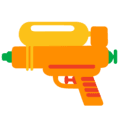
In April 2018, Twemoji 2.6 replaced the realistic revolver with a green plastic water pistol. Apple had done the same in 2016, and after Twitter followed, so did WhatsApp, Samsung and eventually everyone else. Today 🔫 is a toy on essentially every platform.
What makes this interesting is not the politics of it but the mechanics. Unicode defines a character called PISTOL. It does not define what that character looks like. So a coordinated series of independent vendor decisions changed what the character effectively means, without a single line of the standard being edited. The codepoint stayed put and the meaning moved underneath it.
You can still see the divergence in older sets. This is the same character across vendors, and the ones that never updated tell you roughly when they stopped being maintained:


















The route a character takes into the standard before any vendor draws it is a separate story, told in how an emoji becomes an emoji.
The redesign nobody saw
In April 2021, Emojipedia noticed something odd: unfamiliar Twemoji appearing inside Twitter Fleets and in user surveys. They were not flat. They had depth, gloss and a three-quarter camera angle, a complete departure from the house style.
The work was real and substantial. The studio BUCK describes the project as "part-design system, and part-illustration project", with thousands of emoji hand-painted by its concept designers, built around "a 3/4 camera angle that creates dimension". Hiroshi Endo’s account of itputs the scope at more than 5,000 icons over 18 months, redesigned with attention to "color, form, and accessibility" and a stated aim of reflecting a wider range of skin tones, hair textures and cultural representation.
Emojipedia’s editor’s note, added in January 2022, is the quiet part: "As of January 2022, these possible new designs have yet to be implemented." Nine months after they were first spotted, still not shipped. Then the acquisition happened, the design org emptied out, and the question of whether to roll out a five thousand piece redesign stopped being asked.
Somewhere there is a finished, or nearly finished, emoji set that the public only ever glimpsed through a feature that itself no longer exists. Fleets was shut down on 3 August 2021, four months after the new emoji were spotted inside it, having lasted less than a year.
Why it spread so far
Twemoji is on more of the web than any other single emoji set, and the reason is licensing rather than design.
The artwork is CC-BY 4.0 and the code is MIT, a split documented in the project README. Apple, Google, Microsoft and Samsung all keep their artwork proprietary, so if you are building a site and want emoji that look identical for every visitor, your realistic options are Twemoji, OpenMoji, or Noto. For a decade Twemoji was the most complete and best known of those.
That is how it ended up in WordPress core, as a fallback for browsers with incomplete emoji support, which alone put it on a large fraction of the web. Discord used it. So did thousands of smaller projects.
The licence is also why the set outlived its owner’s interest. CC-BY cannot be revoked, so when X stopped maintaining Twemoji, the work simply continued elsewhere. That part of the story, including who picked it up and what X does with emoji now, is covered in our post on X emojis.
One thing worth saying plainly if you are about to use it: CC-BY requires attribution. It is a real condition, not a suggestion, and it is the only thing the licence asks in return.
What the search data actually shows
There is a tempting story here, that abandoning Twemoji made people more curious about it. Searches for "twemoji" have roughly tripled since early 2025, which fits that story neatly.
It does not survive a control. Plotting Twemoji against two other open emoji sets shows all three climbing together from the third quarter of 2025, and OpenMoji rose faster than Twemoji did, roughly thirteen-fold against Twemoji’s three. Whatever is driving this, it is happening to the category, not to Twemoji specifically.
A reasonable guess is that more people are building things that need emoji and discovering they cannot legally use Apple’s. That would lift every open set at once, which is what the chart shows. It is a duller explanation than a revival, and it is better supported.
What is true regardless is the odd position the set now occupies. The company that paid for it stopped shipping it. The studio that redesigned it never saw the redesign go live. And the version people actually install today is maintained by volunteers, is further along than anything corporate Twitter released, and is free because of a decision made in 2014 by people who have all since left.
- A Timeline of Twemoji: 2014 to 2025 (blog.emojipedia.org)
- Twemoji 2.6 Emoji Changelog (blog.emojipedia.org)
- New Glossy Twemoji Designs Appear in Fleets (blog.emojipedia.org)
- Twitter Twemoji, project page (buck.co)
- Hiroshi Endo, Twitter Twemoji (hiroshiendo.com)
- Twemoji, community-maintained fork (github.com)
- The Iconfactory (iconfactory.com)
- Twitter is shutting down Fleets on August 3 (techcrunch.com)
- Emoji support in WordPress core (make.wordpress.org)
- OpenMoji (openmoji.org)
- Noto Color Emoji (fonts.google.com)
- Creative Commons Attribution 4.0 (creativecommons.org)
- Google Trends (trends.google.com)
