
The Dart Already Hit: Why 🎯 Is the Wrong Emoji for Your Resolution (and the Right One Anyway)
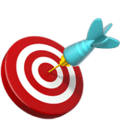
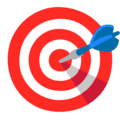
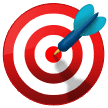
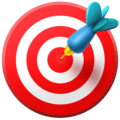
Look at the dart board emoji on your phone right now. 🎯. Look at the bullseye. There is a dart in it. The dart is not flying toward the target. The dart is already there. The Unicode name for this emoji is Direct Hit. Not Target. Not Bullseye. Direct Hit. As in: the shot is over. The thing has been hit. The win has happened.
Every January, an enormous number of people open their phone and use this emoji to mean exactly the opposite. "2026 goals 🎯." "New chapter, new aim 🎯." "Manifesting 🎯." Each of those posts is using a glyph that already shows the goal achieved to express a goal not yet attempted. This post is a tongue-in-cheek expose. The dart already hit. You are sixteen years late.
Copy resolution emojis
The dart already hit
Here is what is actually on your screen. On Apple, Google, Samsung, Microsoft, and Twitter Twemoji, the dart is rendered embedded in the dead center of the bullseye. The yellow tail of the dart sticks out at the eleven-o'clock angle. The shaft is visibly fletched. The shot is complete. The reason every platform draws it this way is in the name. Unicode shipped a scene of a successful throw, not a goal-setting symbol.
The disconnect is small but real. If you wanted to depict the action of aiming, you would draw a hand and a dart and a target separately, with the dart in mid-flight. There is no such emoji. There has never been a proposal for one. So when people needed a glyph for the thing they are aiming at, they grabbed the closest available object and ignored the small embedded detail that the shot was already over. This is fine. It is also funny.

















What 🎯 was originally for
🎯 lives at codepoint U+1F3AF. It was approved in Unicode 6.0 in October 2010, alongside the founding bulk of the modern emoji set. It came in via the Google-and-Apple-led L2/09-025R2 proposal, which standardized 674 characters from the Japanese carrier sets (NTT DoCoMo, KDDI au, and SoftBank). The carriers had been shipping pictograms on their phones since the late 1990s. The proposal's job was to make sure a SoftBank user could text a DoCoMo user without their dart board turning into a different shape on the other end.
That carrier-set origin is important because it kills a tempting alternative theory. Some emoji in Unicode came from the ARIB broadcasting pictograms absorbed in Unicode 5.2 (2009): tiny news-graphic icons used to flag program types in Japanese TV listings. ARIB had a star, a snowman, a rain cloud. ARIB did not have a dart board. 🎯 is not an old news icon. It is a phone-game pictogram from the era when keitai carriers competed on cute keyboards.
The background data document Unicode published in 2010 maps every new emoji to its carrier originals. The dart board was already showing a dart in the center on each carrier glyph. The unification preserved that. Nobody reopened the question. The dart-already-thrown convention is sixteen years old at this point and never debated.
Why it won the resolution slot
New Year's resolutions are old. The Babylonians made them at the Akitu festival roughly 4,000 years ago, mostly promises to gods to return borrowed farm equipment. The Romans turned the calendar so January would be named after Janus, god of beginnings, and used the month to make pledges of good behavior. The modern self-improvement framing is more recent: a Victorian tradition that mainstreamed in the early twentieth century and went fully online in the 2010s.
That is the demand side. Every year, hundreds of millions of people post some version of "here is the thing I want." They need a one-glyph way to point at it. The supply side of the emoji keyboard never gave them a clean option.
🚀 means launch, energy, "to the moon," and GameStop. 💪 means strength but reads as a flex. ✨ means general atmospheric magic, which is almost too neutral. 📈 means literal growth, fine for finance, weird for love or fitness. 🏆 is the prize after the win. 🔥 is heat or hype. None of them say "the thing I am aiming at, future tense, before the work has happened." 🎯 was the only emoji that even had a target shape. So it got the job. The dart in the middle was overlooked.
Build your 2026 resolution
While we are here. Pick a category, drag the ambition slider, and the widget below will give you a copyable goal sentence with the right emoji combo. The realism meter at the top is anchored to Norcross's 2002 finding that 46% of resolvers were still on track at six months. The other tiers are vibes. The 🎯 is, of course, baked in.
Build a 2026 resolution
Odds: about 46%Three workouts a week through February. Not all year. Just February.
🏋️🎯📅
"Realistic" odds reference Norcross's 2002 study finding 46% of resolvers still on track at six months. The other tiers are vibes.
Two of the realistic templates are deliberately small. February-only commitments and single-task quarter-goals beat year-long ambitions in the academic literature. The 2020 Oscarsson PLoS ONE study found approach goals ("do this") outperformed avoidance goals ("stop this") by roughly eight percentage points at one-year follow-up. The widget skews approach.
The runner-ups that lost
For completeness, here is the also-ran roster and why each one failed to take the resolution-emoji crown.
🚀 is too big and too sci-fi. It works for product launches and crypto tweets, not for "learn Spanish." 💪 is great for the gym subset of resolutions but reads slightly bro. ✨ is the polite-girl-Instagram default, which is almost too universal to mean anything specific. 📈 is the LinkedIn finance favorite but only fits goals you can chart. 🏆 is the wrong tense entirely (you have already won). 🔥 is hype, not aim. 📅 is deadlines, not destinations. None of them have a target shape. 🎯 has the target shape. End of story.
Quitter's Day on the calendar
Strava, the activity-tracking app, has been publishing an annual Year-in-Sport report since the late 2010s. In 2019 they analyzed 800 million logged activities and named the second Friday of January as "Quitter's Day", the date by which most resolution-related activity falls off a cliff. In 2026, per Reclaim.ai's tracker, the second Friday is January 9. This post is dated January 4. You have five days.
The Strava methodology is not airtight. They are looking at users of an app that self-selects for fitness intent, so it is a fitness-resolution proxy, not a general-resolution measure. But the cliff itself is widely replicated across other wearables and habit-tracking platforms, and the date sits in roughly the same spot every year. Two weeks is the rough wall most resolution behavior runs into.
The 9% number is folklore
You have probably seen the line "only 9% of people keep their New Year's resolution." It is everywhere. It is not, as far as I can find, in any peer-reviewed paper. The number traces back to Statistic Brain Research Institute, a publisher whose data has been repeatedly flagged as unreliable by Wikipedia and journalism review sites. Pop articles cite the 9% number; the 9% number cites itself.
The actual academic numbers are more encouraging. The canonical Norcross study from 2002, conducted at the University of Scranton, tracked 200 resolvers and 200 nonresolvers and found that 46% of resolvers were continuously successful at the six-month mark, compared to 4% of people who said they wanted to change but did not formally resolve. Resolutions worked. The 2020 Swedish study by Oscarsson and colleagues with 1,066 participants reported 55% one-year success for approach-oriented goals and 47% for avoidance-oriented goals.
Half. Roughly half. That is the actual data. The 9% line is a self-help cliche pretending to be a study. If you want a number for the realism dial in your head, use 46% at six months. The reason it feels lower in your group chat is that you mostly remember the people who fell off, not the half who stayed on.
Other emoji whose names lie
🎯 is not the only emoji whose Unicode name and lived meaning have parted ways. The keyboard is full of these.
💯 Hundred Points Symbol was a Japanese teacher's red-ink "100" mark. It is now Twitter shorthand for agreement, "keep it real," and emphasis. The official name still imagines a graded test. 🥲 Smiling Face with Tear was added in 2020 for bittersweet relief. It became the polite-suffering emoji within weeks: watching your team lose, eating at your favorite restaurant for the last time, sending your kid to college. 🧢 Billed Cap reads, on most platforms, as a generic baseball hat. In AAVE-derived slang, it means "lying." "No cap" means "no lie." Unicode has not been consulted. ⚰️ Coffin means "I am dying laughing" in Italian and Brazilian Portuguese internet slang, where the literal funeral reading is rare and the "dying" metaphor is universal.
Linguist Gretchen McCulloch, inBecause Internet, makes the case that emoji are gestures, not labels. A gesture does not have an official meaning. It has a usage. The Unicode name is the gesture's scientific name; the meaning is whatever the room agrees on. The room agreed that 🎯 means "the goal" sometime around 2014 and has not reconvened.
Send the dart anyway
None of this means you should stop using 🎯 for your goals. Quite the opposite. The whole point is that the meaning of an emoji is the meaning the people sending it have agreed on, not the one Unicode wrote down sixteen years ago. The dart already hit, and the room decided that was fine, and the room is right.
The fun of knowing the official name is that it makes the gap visible. Every January 1 post that uses 🎯 is, technically, declaring victory in advance. Which is, on reflection, maybe a better way to start a resolution than admitting from the first day that you might not finish. The Unicode pictogram and the user-imposed meaning have quietly agreed: the win is already in the bullseye. You just have to walk over and pick up the dart.
- Direct Hit emoji on Emojipedia (emojipedia.org)
- U+1F3AF on Codepoints.net (codepoints.net)
- L2/09-025R2: Proposal for Encoding Emoji Symbols (Davis, Edberg, 2009) (unicode.org)
- L2/10-132: Emoji Symbols Background Data (Unicode, 2010) (unicode.org)
- Emoji on Wikipedia (wikipedia.org)
- New Year's resolution on Wikipedia (wikipedia.org)
- A 4,000-year history of New Year's resolutions (National Geographic) (nationalgeographic.com)
- Where did the New Year's resolution come from? (The Conversation) (theconversation.com)
- How New Year's resolutions started (NPR, 2025) (npr.org)
- Auld Lang Syne: predictors of New Year's resolution outcomes (Norcross et al., 2002) (pubmed.ncbi.nlm.nih.gov)
- A large-scale experiment on New Year's resolutions (Oscarsson et al., 2020) (pmc.ncbi.nlm.nih.gov)
- New Year's resolutions: an APA Monitor solution (2004) (apa.org)
- Most resolutions abandoned by January 19, Strava data (Inc.) (inc.com)
- Quitter's Day 2026 explainer (Reclaim.ai) (reclaim.ai)
- Most popular emojis in 2025 (Buffer) (buffer.com)
- Top emojis 2024 (Meltwater) (meltwater.com)
- Brandwatch Emoji Report (brandwatch.com)
- Hundred Points emoji on Emojipedia (emojipedia.org)
- Smiling Face with Tear on Emojipedia (emojipedia.org)
- Billed Cap on Emojipedia (emojipedia.org)
- Coffin emoji on Emojipedia (emojipedia.org)
- No cap slang entry (Dictionary.com) (dictionary.com)
- Because Internet (Gretchen McCulloch) (gretchenmcculloch.com)
