
The Least Used Emojis: Meet Unicode's Middle Children
Open your emoji keyboard. Scroll past 😂, past 😭, past 🔥. Keep scrolling. Eventually you will meet a 📟. A 📇. A 🚟 that is a train suspended from above, for reasons. A 🪗 that nobody has ever sent you. These are the middle children of Unicode, the 3,953rd-kid-at-the-family-reunion emojis whose parents forgot their birthday again.
According to the Unicode Consortium’s own frequency data, hundreds of emojis sit at less than one-two-thousandth the usage of the top emoji. On Facebook Messenger, the least-used examples include 🤽 water polo and 🕴️ levitating businessman. A 2024 Superside analysis found 👌 is the most endangered globally. Somewhere, a 🚠 mountain cableway is eating alone in the cafeteria.
This post is part pity party, part adoption drive. We are going to meet the bottom of the frequency curve, look at the real search data, and then you are going to take one home. No judgment. They just need a little attention.
Tap a middle child
Meet the middle children
The Unicode Standard currently contains 3,953 emojis as of September 2025. Usage is extremely uneven. A 2024 paper in the Journal of Quantitative Linguistics modeled emoji frequency on Twitter and found it follows a power law with an exponential cutoff around rank 200. In plain terms: a couple hundred emojis do almost all the work and everyone else is, technically, on the payroll.
Meltwater put 😭 at 814 million social media mentions in 2025, briefly dethroned by 🔥 in September. We covered the full top of the curve in our most popular emojis of 2026 ranking. The bottom-tier emojis, by contrast, show up not in hundreds of millions but in low thousands, and mostly as typos. The gap between them is not a gradient, it is a cliff.
This post is not about the cliff edge 😂. It is about the nice quiet emojis sitting at the bottom of the valley, wondering if anyone will ever tap them. 📟, 📇, 🉐, 🔣, and the entire troubled family of cable-car transit variants 🚡🚠🚟🚝.
How we measure a shunned emoji
"Least used" is three different questions wearing a trench coat. There is lowest frequency in text data (Unicode’s tracker, which ingests Twitter samples and private platform reports). There is lowest search interest on Google. And there is the Superside definition of "most endangered", meaning once common but now trending down.
For this post we care about absolute floor emojis: ones that have never had their viral moment, whose platform designs are still slightly janky, whose purposes are specific or regional, whose neighborhoods on the keyboard are sleepy. Flags mostly get excluded because there are just under 270 of them and they are the least-used category almost by definition. What is left is a ragtag group of mailboxes, transit systems, kanji buttons, and instruments.
Read on for the adoption agency, the anatomy of the transit cousins, the Class of 2020 that got drowned out by its more popular classmates, and a chart showing exactly how much space there is between 😭 and 📟. Spoiler, it is all of the space.
The adoption agency
Meet the candidates. Each card shows a real, underused emoji with its Unicode background, its personality, an ideal home, and a copyable adoption gift combo. Tap "Next" to cycle through. Tap "Adopt" to copy the combo to your clipboard and send it to the least deserving group chat you are in. We will not check on you afterwards.
Adopt a forgotten emoji
0/12 adoptedPager
Unicode 6.0, 2010
Joined Unicode the same year Sony quietly killed off the floppy disk. Represents a device US subscribers peaked at 61 million in 1999 and then abandoned. Still gainfully employed in hospitals, where about 2 million units are on the clip.
Personality
Ideal home
Acknowledging a group chat ping from across the room. Good in threads about being paged for something dumb.
Adoption gift
Adopted one? Good. If you send 📟🏥🧑⚕️ to a doctor friend, you are now the most relatable person in their day. If you send 🪗🎶🍻 to your group chat, you are announcing a personality. This is how forgotten emojis get rehabilitated.
Exhibit A: the transit cousins nobody can tell apart
Unicode contains four different "cable suspended from above" emojis. They were all approved as part of Unicode 6.0 in 2010 in a bulk import from the earlier Japanese carrier sets. They are all still there. Here they are, side by side, for the first time in most people’s lives.
Six transit emojis, all with niche meanings, all picked in Jason Snell’s 2016 list of least-loved emojis. The funny part is that a real transit nerd can tell you why each one matters. The Schwebebahn in Wuppertal, the original suspension railway, has been running continuously since 1901. The monorail emoji has a direct lineage to the Tokyo Monorail, which opened for the 1964 Olympics. Every one of these emojis is a love letter to a specific piece of infrastructure you have probably never thought about.
Exhibit B: the Japanese kanji buttons
Scroll to the bottom of the Symbols tab and you will find a cluster of square, colored buttons containing Japanese characters. They look like municipal signage because they mostly are. As Coto Academy explains, these are direct imports from the original NTT Docomo and SoftBank pagers and feature phones, which is why they look more like office stamps than like emoji.
If you are reading this in Japan these are totally normal. If you are reading this anywhere else, congratulations, you have just met an entire subregion of your emoji keyboard for the first time. Nippon.com has a full primer on these if you want to keep going. Or you can just send 🉐 to somebody who got a Black Friday deal and enjoy their confusion.
Exhibit C: the Emoji 13 Class of 2020
Unicode 13.0 shipped in March 2020 with 117 new emojis. Some of them went on to become huge. 🥲 smiling face with tear became a pandemic mascot. 🫂 people hugging became the Discord moderation icon of a generation. And then there was the rest of the class, who graduated into a world that just never called.
The accordion 🪗 rarely cracks into mainstream rotation. The long drum 🪘 is in a similar place. The sewing needle 🪡, approved the same year in the same batch, has the saving grace of being useful metaphorically ("threaded the needle") but even then its search volume is dwarfed by siblings like 🧵 thread, approved two years earlier. Order of arrival matters and so does timing. 2020 was a great year to be a sad emoji and a terrible year to be an accordion.
What pager search looks like next to crying
This is the cliff we keep talking about. Google Trends quarterly data from late 2020 to early 2026 for four emoji-specific queries. 😭 and 🔥 sit near the top of the chart the entire time. 📟 and 🪗 sit on the floor, only registering when somebody briefly writes an explainer about them. The proportions are real.
Source: Google Trends
The 2025 Q4 spike on 😭 corresponds to the Meltwater cycle where it posted over 814 million social mentions in a single year. The pager line hits 2 in one quarter and zero for the rest. The accordion line is fundamentally a line of zeros interrupted by the occasional confused music teacher. This is what the long tail of emoji usage actually looks like: a cliff, a floor, and a scattering of dust.
How to actually use a forgotten emoji
The trick with underused emojis is irony. In the same way Gen Z rehabilitated the rotary phone emoji as a punchline about old technology, you can revive a middle-child emoji by leaning all the way into how random it is. Specificity is the whole joke. Here are some real combos that work.
Each of these works because it is doing a specific job a common emoji cannot do. The pager carries 1990s residual meaning that 📱 simply does not. The rolodex is the only emoji that says "before smartphones" in a single glyph. The suspension railway is the most niche transit flex available. If your group chat is full of people who already text 🔥 every ten seconds, switching to one of these is how you get the reply "what is that".
Platform rendering makes it worse
Popular emojis get redrawn every few years. Apple, Google, and Samsung employ actual design teams for their emoji fonts. But design teams prioritize what people use. So the popular emojis get loving updates and the unpopular ones stay visually frozen in 2012. The accordion, the pager, and the suspension railway look noticeably rougher on most platforms than 😭 does. Swipe through and see.






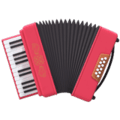













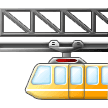















Samsung’s early TouchWiz renderings of these emojis are particularly rough. Microsoft’s Fluent redesign in 2022 gave 😭 an overhaul but left most of the bottom-tier items untouched. The less an emoji gets used, the less love it gets, the less recognizable it is, the less it gets used. It is a death spiral with a 🪗 soundtrack.
What not to send (to normal people)
A forgotten emoji dropped without context in the wrong chat reads as a typo. A few specific landmines to avoid.
Nobody knows what this means. It will be read as either 'confidential' or 'broken attachment icon'. If you want to signal privacy, 🔒 works. If you want to signal a signature, ✍️ works. 🔏 does neither convincingly.
It will render as a red square with a character they cannot parse. You will look like you have mistapped or like your autocorrect is broken. Save for groups where at least one person reads Japanese, or for very specific 'good deal' irony bits.
To anyone under 35 this will read as a niche joke. It is a niche joke. That is fine, but do not pretend you are being practical when you send 'ping me 📟', you are being a character.
You are not on a suspension railway. Almost nobody is. If you want 'on my way' use 🚆 train, 🚗 car, or 🚶 walking. Saving the 🚟 for when you are, in fact, in Wuppertal, is a power move.
This emoji is iconic because it is unhinged. In a LinkedIn message or a work email it reads as either cursed or sarcastic. Save it for group chats where the tone is already broken.
In defense of the middle children
The Unicode Consortium does not retire characters. Its stability policy means every emoji approved gets to stay, forever, on every keyboard. The suspension railway, the pager, and the rolodex will all outlive every human currently reading this post. They will still be on the keyboard on every phone sold in 2040. Our great-grand children will tap 📟 and have no idea what it ever was, the same way we now tap 💾 without having owned a floppy disk.
That is actually a gift. Popular emojis age badly because meanings drift. 🍑 became a joke, 🥺 became a meme, 👌 picked up a politicized reading it never asked for. The middle children stay still. They are preserved in their original, modest, specific use case. They are the Unicode equivalent of a well-lit hallway in a museum you have not visited yet.
So adopt one. Use it weird. Give a random 📭 to the group chat. Send 🪗 when somebody announces they joined a polka band. Drop 🚟 in reference to literally nothing. The more we use them, the more Unicode’s frequency curve flattens, and the better the platform design teams will treat them the next time they refresh. Middle children deserve love. Also, a rolodex is coming back into style, probably. Stay tuned.
- Emoji Frequency (home.unicode.org)
- Facebook Reveals Most and Least Used Emojis (blog.emojipedia.org)
- Which emojis are going extinct? | Superside (superside.com)
- Top 10 least-loved emojis (sixcolors.com)
- Top Emojis of 2025: Platform, Country, and Generation Trends (meltwater.com)
- The Most Popular New Emoji of 2025 (blog.emojipedia.org)
- Linguistic Properties of Emojis: A Quantitative Exploration (tandfonline.com)
- Japanese Kanji Emojis: What Do They Actually Mean? (cotoacademy.com)
- Picture This: A List of Japanese Emoji (nippon.com)
- 117 New Emojis In Final List For 2020 (blog.emojipedia.org)
- Wuppertal Suspension Railway (wikipedia.org)
- Unicode Character Database Stability Policy (unicode.org)
- Emoji history: the missing years (blog.gingerbeardman.com)
- emojitracker: realtime emoji use (emojitracker.com)
