
The Skeuomorphic Graveyard: Emojis That Outlived Their Objects
Pull up your emoji keyboard and scroll to the Objects tab. You are looking at a museum. A 3.5-inch floppy disk nobody has written data to in fifteen years. A fax machine nobody born after 2005 has ever dialed. A rotary phone that went out of style before most of us could read. A camcorder, a cassette, a CRT television, a pager. All of them still there, still maintained, still tapped thousands of times a day.
This is the weird thing about emoji. Unicode doesn’t retire characters. Once a glyph is in the standard, it is in forever, the same way the letter "q" is in forever even though English barely uses it. So the keyboard keeps collecting the shapes of objects the world stops making. It is the most literal time capsule we own.
Tap a tombstone
Your phone is a museum
Designers have a word for this. The icon on your save button is a skeuomorph: a digital element that mimics the appearance of the physical object it replaced. Apple was famous for the style under Scott Forstall, with the stitched leather of the pre-iOS 7 Notes app and the wood-grain bookshelves of Newsstand. Jony Ive killed that visual language in iOS 7, arguing that users no longer needed the crutch of a familiar-looking object once they were comfortable touching glass.
Emoji never got the memo. Flat design took over app icons and operating systems in 2013, but 💾, 📠, and ☎️ stayed exactly where they were, because the Unicode Consortium’s job is standards, not fashion. A character approved in 2010 has to render recognizably on a phone shipped in 2030. The stability policy is almost religious about it.
The result is a keyboard that looks increasingly strange. Entire generations now grow up with emoji that depict devices they have never seen working. Below is a short field guide to the exhibits, starting with the anchor piece.
Exhibit A: the floppy disk
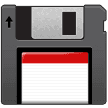
The 💾 emoji was approved as part of Unicode 6.0 in 2010. It depicts a 3.5-inch diskette, the last mass-market version of the format, which held all of 1.44 megabytes, less than a single modern phone photo. Sony, which sat on roughly 70% of the Japanese market, ended domestic sales in March 2011. Annual shipments had already cratered from 47 million disks in 2002 to about 12 million in 2009.
And yet the floppy refused to leave government. The Japanese bureaucracy mandated submission on physical floppies for more than a thousand procedures well into the 2020s, a policy that Digital Minister Taro Kono publicly made his enemy. On June 28, 2024 he told Reuters "we have won the war on floppy disks", with all 1,034 floppy-mandating regulations repealed except one odd holdout involving vehicle recycling. Other governments are still running older systems on floppy, including parts of the US Air Force nuclear command until 2019.
So the emoji is both an ancient artifact and a living object. The shape is preserved in Unicode. The disk is preserved in the back rooms of legacy agencies. The only thing that really died is the idea that you could email someone 1.44 megabytes of spreadsheet.
Exhibit B: the fax that refuses to die
📠 is the most stubborn emoji on this list, because the machine it depicts is genuinely thriving in places you would not expect. Roughly 25% of Japanese households still used a fax machine as of 2023. During COVID, the Ministry of Health received case reports by fax, with nurses literally handwriting patient details and pushing them through phone lines. A cloud portal opened in May 2020; hospitals mostly ignored it.
The US is not much better. American healthcare still runs on fax because HIPAA compliance paperwork is already written around it. The global fax market, per one 2024 estimate, is still worth about $1.5 billion a year. So when Gen Z types 📠 ironically in a group chat ("sending this bureaucratic nightmare your way 📠"), the irony is layered: the object is older than them, but a specialist in Tokyo is, at that same moment, really using one.
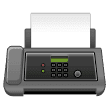
Fun detail. The fax emoji on most platforms still shows a tray of thermal paper curling out of the front. Modern faxes are usually just a line item in a multifunction printer, so the emoji preserves an older, more specific shape than most current faxes have.
Exhibit C: the VHS tape
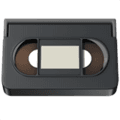
The 📼 videocassette emoji depicts the VHS format specifically, with two spindles and the cutout for the playback door. Funai Electric, the last company making VCRs anywhere in the world, shut the line down at the end of July 2016, forty years after the format launched. At its peak the company was selling 15 million VCRs a year. By the final year it was down to 750,000, and key component suppliers were quitting the business because demand had vanished.
The emoji itself predates the end of production by six years. It was standardized in Unicode 6.0 in 2010, which means the tape was already a symbol of nostalgia (a Gen X-and-up thing) at the exact moment Apple, Google, and Samsung were designing its flat glyph. Samsung’s old Galaxy TouchWiz design even drew the label on the cassette spine, in the same style as a 1990s Blockbuster rental.
The 🎞️ film-frames emoji and 🎥 movie-camera emoji sit right next to 📼 on the keyboard. Together they form a three-object monument to an entire dead ecosystem: shoot on film, record to tape, play on the VCR.
Exhibit D: the rotary phone
The ☎️ telephone emoji is the oldest in this post. It was added to Unicode 1.1 in 1993, back when emoji were not even emoji yet, just Dingbat-style symbols on fax-era Japanese carriers. Most platform designs render it as a black rotary phone with the handset cradled on top. Apple’s current design keeps the dial face even though rotary dialing was replaced by touch-tone in US homes by the late 1980s.
The 📞 telephone receiver (Unicode 6.0, 2010) is the modern sibling, but even that design shows a corded handset pulled off a wall phone. Nobody under 20 has grown up with a corded phone in the house. The Pew Research Center reported that US landline subscriptions fell from a near-universal majority to about a third of households during the 2010s. The emoji for "call someone" is now a historical diagram.
The most interesting cousin here is 🕽, the right-hand telephone receiver, added in Unicode 7.0 in 2014. It was proposed alongside dozens of pictographs from Wingdings and Webdings that got folded into Unicode for legacy interchange. It is on every keyboard on Earth and almost nobody ever uses it.
Exhibit E: everything else still on your keyboard
Once you start counting, the graveyard gets big. Quick tour:
- 📟 Pager. US pager subscriptions peaked around 61 million in 1999 and collapsed with cellular texting. Pagers live on in hospitals: NPR reported that 81% of healthcare organizations still use them because pager signals penetrate concrete basements better than cellular. About 2 million pagers are still active.
- 📇 Card index (Rolodex). Added in Unicode 6.0. The physical Rolodex brand survived for decades after CRM software replaced the workflow, but nobody under 35 has ever spun one to find a contact. The emoji persists as a metaphor for an address book that nobody owns.
- 🕰️ Mantelpiece clock. A wind-up clock carved like a small cathedral, added in Unicode 7.0. This is an object most people only see in antique shops, yet it lives on the keyboard.
- 📺 Television. Most platforms still render the TV emoji as a CRT, despite flat panels taking over in the late 2000s. Hitachi, Sony, and the other Japanese makers stopped CRT production in the mid-2000s. Apple and Twemoji have flatter silhouettes, but Samsung and Google still draw knobs.
- 📷 Film camera. The Instagram icon, before it was rebranded into a gradient square in 2016, was itself a skeuomorph of a Polaroid-adjacent camera. The emoji keeps the shape.
- ⌨️ Keyboard, 🖱️ computer mouse. Both still depict the dedicated-device era: a rectangular keyboard and a two-button mouse, on a generation of people typing into glass and tapping trackpads.
- 💿 📀 Optical disc. The CD and DVD emoji are already nostalgia markers. Global CD sales have fallen about 95% from their 2000 peak.
Worth flagging: the emojis above are what the glyphs officially depict, but each platform draws them slightly differently. 💾 on Apple is a beige diskette; on Google, a blue one; on Microsoft, barely a diskette at all. Here is the side-by-side.

























































Why Unicode won’t let them die
The reason your keyboard keeps getting older, never younger, is baked into the Unicode Consortium’s character stability policy. Once a codepoint is assigned, it can never be removed, un-assigned, renamed, or re-used. The name might be slightly corrected, but the glyph behind it is locked in for the life of the standard. This is how every computer in the world, today or in 2080, agrees on what character is at any given address.
The side effect is that emoji are collected, never curated. The pager does not get retired when pagers retire. The floppy does not get retired when Sony shuts the line down. Platforms can redesign how they draw the glyph, and many do quietly, but the shape Unicode ratified keeps setting the baseline. If you want the full pipeline, from someone pitching a glyph to the day it appears on your phone, I wrote a companion piece on how an emoji becomes an emoji.
That is why the keyboard is still getting searched at real volume. The chart below is Google Trends data for the four anchor devices of this post, 2021 through early 2026. Relative search interest is not the same as units sold, but it tells us how often real people are typing these words into a search bar.
Source: Google Trends, 2021 Q1 – 2026 Q1
Floppy-disk interest has the lumpy profile of a class taught every autumn: every Q1 and Q3 it spikes as students and tech journalists write explainer pieces. Fax machine hits an enormous spike in 2026 Q1, almost certainly driven by coverage of Germany’s court system finally abandoning fax and the ongoing Japanese modernization push. Rotary phone creeps up year over year, as aesthetic TikToks and retro home decor make it a prop again. None of these objects are, in search terms, actually dead.
The save-icon problem
The 💾 emoji has a specific second life that most of the others do not: it is also still the save icon in Microsoft Word, Excel, PowerPoint, and a long tail of desktop software. Nielsen Norman Group ran a formal usability study and found that about 83% of users still recognize the floppy as "save", including young users who have never touched the physical object. The icon has detached from the thing and become pure signage.
This is where the generational comedy lands. In 2019 a Japanese parent posted their child’s question on Twitter: "why is the save icon a vending machine with a drink coming out the bottom?" Floppies had become so alien that the brain reached for the nearest modern shape. Stack Overflow’s podcast spent an entire 2022 episode on the adjacent problem: Gen Z engineering interns often do not have a mental model of a nested file system, because their whole computing life has been in apps and cloud buckets that just search.
This is the 💀 moment of the post, honestly. The emoji has outlived the object, outlived the file format the object stored, and is now outliving the very concept of "a file you save to a place."
Date the dead tech
Six objects. For each, pick the year the last mainstream unit rolled off the assembly line (or the year the technology was effectively retired from consumer life). The reveal includes a short epitaph and a source. Share your score at the end.
Time of death
1/6When did the last 3.5-inch floppy disk roll off the assembly line?
If you score four or more, you probably remember at least two of these working. If you score two or fewer, congratulations, your brain is running on fresh stock. Either way, the keyboard is the same.
Dead-tech combos that still work
Skeuomorphic emoji have a second act in chat: irony. Sending 📠 with a bureaucratic task shows you know the joke. Sending 💾 in a tech team Slack is how you acknowledge a piece of work is done. Here are the combos that land, tap to copy.
Dead-tech emoji landmines
Three ways these glyphs can backfire in a modern chat.
In most phone apps the save action is a checkmark, not a floppy. The person on the other end reads 💾 as retro nostalgia, not confirmation. Use ✅ or 📒 instead.
If your accountant or lawyer in Japan reads it literally, you are confirming an outdated workflow. Stick to 📧 or 📄 unless the joke is explicitly about the legacy system.
☎️ reads as "audio only, rotary era". 📱 or 🎥 are better for "let us hop on Zoom". The subconscious association is old-landline, not Google Meet.
What dies next
The interesting part of a graveyard is always the newest headstone. A few objects on the current keyboard are aging faster than the rest and will probably be tomorrow’s skeuomorphs.
🖨️ the printer is the obvious candidate. Office printing volume in the US fell roughly 30% from 2019 to 2023 as remote work erased the daily reflex of printing a document. The next generation will know the icon more than the object.
🔑 the house key is another one. Smart locks are still a minority of the US market, but adoption is growing roughly 15% per year. In apartment buildings in Stockholm or Seoul, unlocking a door with a metal shape in your hand is already the old way to do it.
And the long-term candidate, the one that might be saddest: 💵 paper money. Sweden’s central bank reported that less than 9% of retail payments in 2023 used cash. A generation from now, the dollar-bill emoji might sit next to the floppy in the exhibit hall.
Until then, the keyboard stays the way it is. Unicode keeps admitting new glyphs, almost never removing old ones, and the floor of the museum slowly expands. Every three years a new device gets shelved, keeps its icon, and waits for someone to tap it ironically in a group chat.
Your phone is a museum. Admission is free. Start with the 💾.
- Sony to halt floppy disk sales in 2011 (computerworld.com)
- Japan's digital minister claims victory against floppy disks (theregister.com)
- The last VCR to be made this month (variety.com)
- R.I.P. The world's last VCR (money.cnn.com)
- Why do doctors still use pagers? (npr.org)
- Japan hospitals still use fax machines for coronavirus (scmp.com)
- The floppy disk icon as 'save': still appropriate today? (nngroup.com)
- Gen Z doesn't understand file structures (Ep. 415) (stackoverflow.blog)
- What Apple learned from skeuomorphism (appleinsider.com)
- Unicode character encoding stability policy (unicode.org)
- Emojipedia: floppy disk (emojipedia.org)
- Emojipedia: telephone (rotary) (emojipedia.org)
- Cathode ray tube history (wikipedia.org)
- Fax machine market report, 2024 (cognitivemarketresearch.com)
