
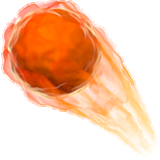
Proposal sketch. This emoji isn’t on keyboards yet, targeted for September 2026 (targeted).
Meteor Emoji
U+1FA8B:meteor:About Meteor [meteor]
Meteor () is part of the Travel & Places group in Unicode. Added in Unicode E18.0. Type on GitHub and Slack to use it. Click copy above to grab it, paste it anywhere.
Works in iMessage, WhatsApp, Discord, Slack, Instagram, Twitter, Gmail, and every app that supports Unicode.
Often associated with meteor, shooting, star, and 3 more keywords.
Meaning varies across cultures, see cultural notes below.
Scroll down for the full story: meaning, trends, combos, and more.
How it will look
Vendor designs won’t exist until Unicode 18.0 ships. These are the proposal sketches and reference designs Unicode used to evaluate the candidate.
The 72px sample from Unicode's meteor emoji proposal.
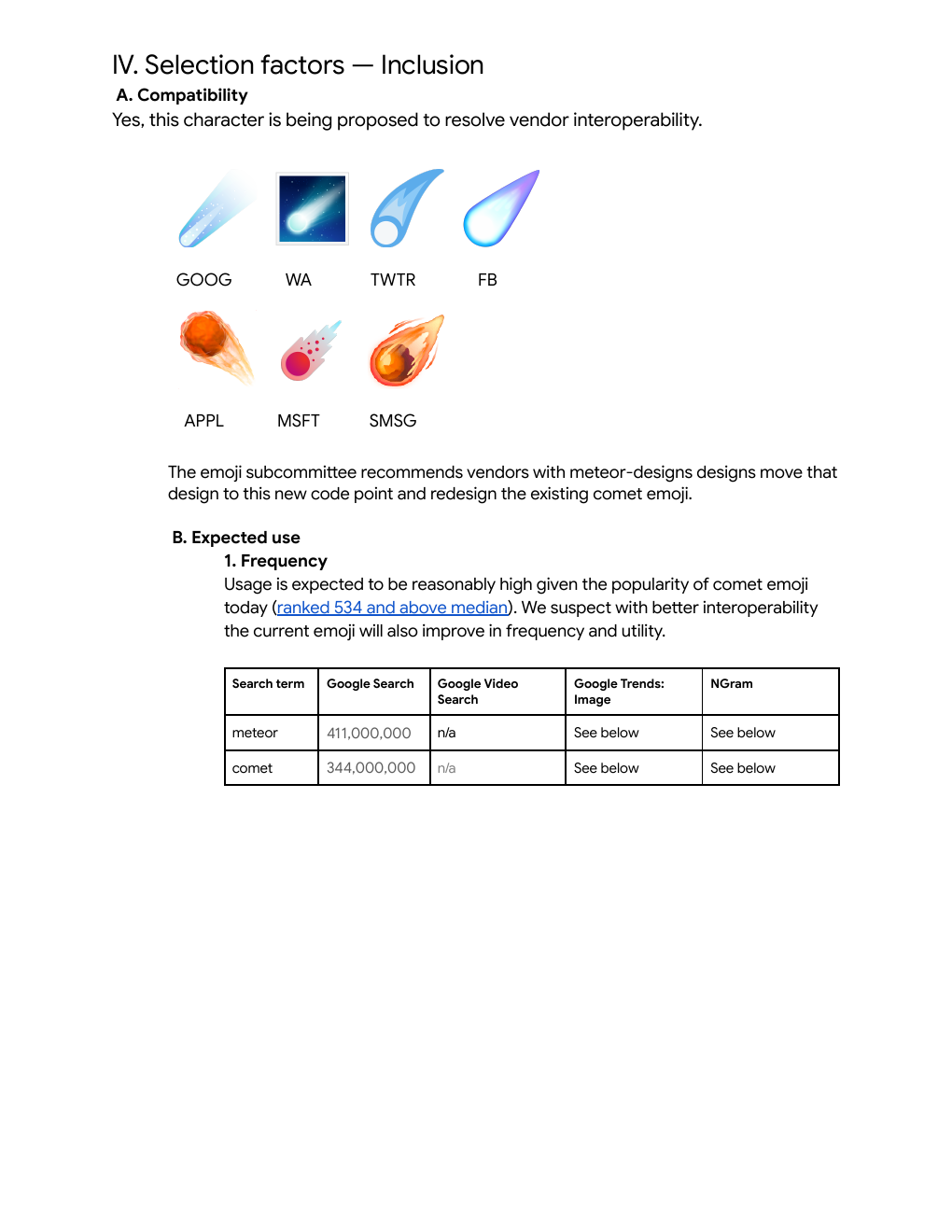
Vendor drift on ☄️ Comet. Google, WhatsApp, Twitter, Facebook drew a proper comet. Apple, Microsoft, and Samsung drew a meteor. The proposal's core argument: lets the meteor-looking designs migrate to a correct codepoint.
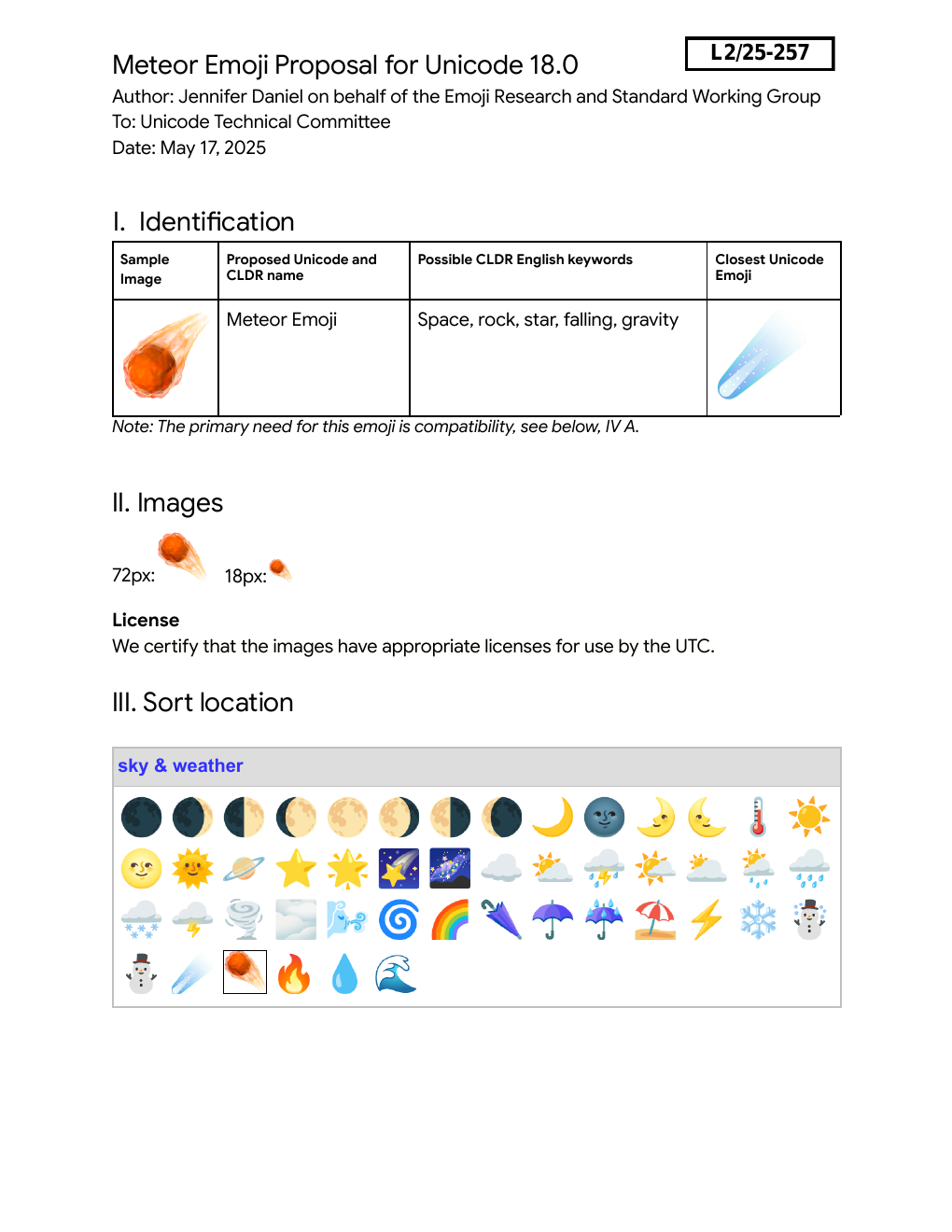
Page 1 of the proposal document, showing the proposed name, keywords, and closest existing Unicode emoji (☄️).
What does it mean?
[meteor] Meteor is a burning streak of rock crossing the sky, drawn as a bright fiery head with a glowing trail behind it. It fills a specific astronomical gap: Unicode has had ☄️ Comet (a long-orbit icy body with a diffuse gas tail), ⭐ Star (a static sun), and 🌠 Shooting Star (actually a stylized wish symbol, not an astronomical object) since 2010, but no dedicated glyph for a meteor, meteorite, or atmospheric fireball.
The more interesting part of the meteor proposal is that it's a cleanup job. Most major vendors (Apple, Google, Microsoft, Samsung, Meta) have been quietly drawing what is clearly a meteor when rendering ☄️ Comet for years. The Unicode Emoji Subcommittee's fix: let the incorrect meteor designs migrate to this new codepoint, then make every vendor redraw ☄️ as a proper comet. It's a rare case of Unicode using a new emoji to force a design reset on an existing one.
Expected usage pattern: astronomy content (meteor showers pulling millions of views on TikTok and YouTube Shorts), gaming (impact abilities, falling-meteor attacks), news coverage of notable fireballs like Chelyabinsk in 2013, and the metaphor cluster around sudden impact: "meteoric rise," "meteoric career," "hit like a meteor." Worth noting that the original 19th-century meaning of "meteoric" emphasized transient brilliance, not just speed: meteoric things soared, then burned out. Modern usage dropped the second half.
Sky objects in emoji, compared
| ⭐ Star | 🌠 Shooting Star | ☄️ Comet | Meteor | |
|---|---|---|---|---|
| What it is | Distant sun | Wish symbol | Icy orbiting body | Rock in atmosphere |
| Duration | Years | N/A (symbolic) | Weeks to months | Seconds |
| Motion | Appears static | Streak with sparkle | Slow arc with tail | Fast fiery streak |
| Speed | N/A | N/A | Dozens of km/s | 11 to 72 km/s |
| Use case | Favorites, ratings | Wishes, dreams | Rare events, sci-fi | Meteor showers, impact |
Emoji combos
Peak meteor rate by annual shower
Meteor shower calendar
- 🗓️Quadrantids: Peaks ~January 3. Short peak (6 hours), up to 80/hr. Coldest watching of the year.
- 🗓️Lyrids: Peaks ~April 22. Modest ~15/hr but the oldest recorded shower (~2,700 years of observations).
- 🗓️Perseids: Peaks ~August 12 to 13. Up to 60/hr. The big summer one, maximum social reach.
- 🗓️Orionids: Peaks ~October 21. Up to 20/hr. Debris from Halley's Comet.
- 🗓️Leonids: Peaks ~November 17. Usually modest (~15/hr), occasional storms hitting 1,000+/hr.
- 🗓️Geminids: Peaks ~December 13 to 14. Up to 120/hr. The densest annual shower, multicolored meteors.
Origin story
[meteor] was proposed in 2025 (L2/25-257) by members of the Unicode Emoji Subcommittee. The argument had two parts. First, astronomy communicators had been flagging for years that there was no emoji for a meteor, only ☄️ Comet (wrong physics, wrong timeline) and 🌠 Shooting Star (actually a wish symbol). Meteor-shower content has ballooned on TikTok and YouTube Shorts since 2022 without a dedicated shorthand. Second, and more pragmatically, several major vendors had been rendering their ☄️ Comet glyph as a meteor for years, and Unicode wanted a clean way to migrate those designs to a correct codepoint and reset ☄️ to a proper comet. [meteor] is targeted for Emoji 18.0, September 2026.
Read the proposal
Other Emoji 18.0 draft candidates
Meteor Pickle
 Cracking Face
 Lighthouse
Design history
- 2010☄️ Comet (U+2604) is included in Unicode 1.1 emoji mapping, but rendered by most vendors as a meteor-like streak, not a proper comet.
- 2016🌠 Shooting Star migrates from 2010 to become widely used. Astronomers point out it's labeled a 'wish symbol,' not an astronomical body.
- 2022Meteor-shower content (Perseids, Geminids) surges on TikTok and YouTube Shorts. Creators default to ☄️ or 🌠 for lack of a correct option.
- 2025Proposal [L2/25-257](https://www.unicode.org/L2/L2025/25257-emoji-meteor.pdf) submitted to the Unicode Emoji Subcommittee, combining the astronomy-gap argument with a fix for vendor-design drift on ☄️ Comet.
- 2026 Meteor advances to the Emoji 18.0 draft candidate list, targeted for September 2026 ratification.
Not yet. It's part of the Emoji 18.0 draft candidate set, targeted for September 2026. Unicode can still rename, redesign, or reject candidates at any point before ratification.
Two reasons. First, ☄️ is a comet (long-orbit icy body), not a meteor (atmospheric streak), and astronomers have pushed for a proper meteor glyph for years. Second, most major vendors had been rendering ☄️ Comet as a meteor-looking streak. [meteor] gives those designs a correct home and forces vendors to redraw ☄️ as a real comet.
A bright fireball head trailing a glowing yellow or orange tail, drawn at a diagonal angle. Vendor drafts typically set it against a dark background to emphasize the glow, with no ice tail, no nucleus, and no sparkles.
Unicode defines the concept, not the design. Expect each vendor to draw their own interpretation, just like they do with every other emoji. Based on existing meteor-like ☄️ renderings, Apple will likely go fiery and dramatic, Google more geometric, Samsung more cartoon, Microsoft more flat-illustrated.
Around the world
Global astronomy communities
Amateur astronomers in the International Meteor Organization have lobbied for a meteor-specific emoji since the mid-2010s. The correct emoji is a bigger deal in this community than mainstream users realize.
United States
Expect heavy usage around Perseids (peak night of August 12) and Geminids (peak night of December 13). Both are prime stargazing events promoted by NASA's public outreach.
Russia
The Chelyabinsk fireball of February 2013 is the biggest civilian meteor event of the modern era. Usage in Russian-language space content spikes around its anniversary.
Japan and East Asia
Shooting-star wish culture (流れ星 nagareboshi) already has a well-established emoji in 🌠. [meteor] is more likely to be picked up for news and gaming than for wish-making, which stays with the older glyph.
The major annual showers: Perseids peak around August 12, Geminids around December 13, Quadrantids around January 3. The Lyrids in late April and the Leonids in mid-November are reliable smaller showers. Meteor-shower watch-party posts will be an early use case.
Yes, and the metaphor is even older than you'd expect. 'Meteoric rise' shows up in print in the 1860s, and 'meteoric career' exists as early as 1823. Interestingly, the original sense emphasized the brief burnout part, not just the speed. Modern usage lost that half.
Often confused with
A meteor is a piece of rock burning up in Earth's atmosphere, visible for a few seconds. A comet is a ball of ice, dust, and rock orbiting the sun, visible for weeks or months with a long tail. A 'shooting star' is the colloquial name for a meteor, but the 🌠 emoji specifically represents the 'make a wish' cultural symbol, not the astronomical event. [meteor] fills the actual-meteor gap.
Caption ideas
Fun facts
- •The proposal that created [meteor] was mainly a cleanup: most major vendors had been rendering ☄️ Comet as a meteor, and Unicode used [meteor] to migrate those glyphs to a correct codepoint (L2/25-257).
- •At peak, the Geminids produce up to 120 multicolored meteors per hour, making them the densest annual shower despite less famous than the Perseids.
- •Meteors enter Earth's atmosphere at between 11 and 72 kilometers per second. The brightness comes from compression heating of air in front of the rock, not from friction.
- •'Meteor' and 'meteorology' share a root: the Greek meteōros, 'high up.' Weather and meteors were lumped together until the 17th century.
- •The Chelyabinsk meteor of February 15, 2013 was the brightest civilian-era fireball, captured on hundreds of dashcams because Russian drivers routinely record their commutes.
- •The phrase 'meteoric rise' first appears in print in the 1860s, per World Wide Words, but 'meteoric career' existed as early as 1823.
- •Apple, Google, Samsung, Microsoft, and Meta all drew their ☄️ Comet with a meteor-like glow and streak for years, a design drift Unicode calls out directly in the proposal.
- •The Quadrantids (peak around January 3) are named after a defunct constellation, Quadrans Muralis, that was removed from the IAU star charts in 1922.
Trivia
- Meteor Emoji Proposal L2/25-257 (PDF) (unicode.org)
- Meteor on Emojipedia (emojipedia.org)
- Emoji Candidates (Emoji 18.0) (unicode.org)
- Draft Emoji List 2026/2027 (Emojipedia blog) (emojipedia.org)
- Meteor showers and dates (NASA) (nasa.gov)
- Meteor Shower Calendar (American Meteor Society) (amsmeteors.org)
- 'Meteoric rise' etymology (World Wide Words) (worldwidewords.org)
- Chelyabinsk meteor (Wikipedia) (wikipedia.org)
- International Meteor Organization calendar (imo.net)
- Almanac: Geminid Meteor Shower (almanac.com)
Related Emojis
More Travel & Places
Share this emoji
2,000+ emojis deeply researched. One click to copy. No ads.
Open eeemoji →