
Pencil Emoji
U+270F:pencil2:About Pencil ✏️
Pencil () is part of the Objects group in Unicode. Added in Unicode E0.6. Type on GitHub and Slack to use it. Click copy above to grab it, paste it anywhere.
Works in iMessage, WhatsApp, Discord, Slack, Instagram, Twitter, Gmail, and every app that supports Unicode.
Meaning varies across cultures, see cultural notes below.
Scroll down for the full story: meaning, trends, combos, and more.
How it looks
What does it mean?
A classic yellow pencil with a sharpened graphite tip and pink eraser, angled as if mid-stroke. The ✏️ is one of the oldest emoji characters in Unicode, dating back to version 1.1 in 1993, inherited from the ITC Zapf Dingbats) typeface.
What makes ✏️ different from every other writing emoji? The eraser. That little pink nub at the top is the whole personality. A pen commits. A fountain pen formalizes. The pencil? It can take it all back. That makes it the natural choice when you're drafting, sketching, brainstorming, or just thinking out loud.
In texting, ✏️ shows up for anything related to writing, drawing, editing, or education. Students drop it in back-to-school posts. Teachers use it in classroom materials. Artists and illustrators pair it with 🎨 for creative content. App designers know it as the universal "edit" icon, the little pencil that means "tap here to change something."
The yellow color isn't random, either. In 1889, Czech company Koh-i-Noor Hardtmuth painted their premium pencils yellow to signal that the graphite inside came from China, where yellow represented royalty and prestige. The marketing worked so well that competitors copied it, and yellow became the default pencil color worldwide. Every vendor's ✏️ emoji keeps that tradition alive.
✏️ occupies a steady, unglamorous lane in emoji usage. It's not trending, not viral, not particularly cool or cringe. It just shows up wherever writing and education do.
On Instagram and TikTok, it's a staple in #StudyTok and #BackToSchool content. Captions like "first day ✏️📚" spike every August and September. Teachers on TikTok use it in lesson-related posts, and the studygram community pairs it with 📝, 📖, and ☕ for aesthetic study flat-lays.
On Twitter/X, ✏️ appears in threads about drafts, edits, and work-in-progress updates. Writers and journalists use it when sharing early drafts or noting corrections.
In professional contexts, it shows up less than 🖊️ for contract signings, because pencil implies something impermanent. You don't sign a deal in pencil.
Search interest for ✏️ has grown roughly 4x since 2020, but it still trails ✍️ (the writing hand) and 📝 (the memo pad) in overall volume. Among writing emojis, ✏️ sits solidly in third place.
It represents writing, drawing, editing, or education. People use it when talking about schoolwork, creative projects, sketching, note-taking, or anything draft-related. The pencil's eraser gives it a unique "work in progress" connotation that pen emojis don't have.
The Writing Instruments Family
The Desk Stationery Family
 Eraser
What it means from...
Not a flirty emoji. If your crush sends ✏️, they're probably talking about actual schoolwork, a drawing, or editing something. Don't read romance into this one.
"Study session later? ✏️📚" or "Working on my sketch ✏️🎨". Straightforward, no hidden meaning.
Often means "I'm editing that" or "I'll draft something." In Slack and Teams, ✏️ frequently accompanies document edits and revision notes.
Parents and kids: homework time. "Did you finish your assignment? ✏️" is universal parent-speak.
On social media, usually accompanies educational content, art posts, or creative work. No subtext.
The pencil emoji isn't flirty or romantic. If someone sends you ✏️, they're almost certainly talking about actual writing, studying, or creative work. It's one of the most literal emojis out there.
Emoji combos
Origin story
The pencil's real-world history stretches back to 1564, when a massive deposit of pure graphite was discovered in Borrowdale, England. Locals quickly realized the dark material could mark sheep and, more importantly, paper. By the 1700s, Nicolas-Jacques Conte in France figured out how to mix graphite powder with clay and fire it in a kiln, creating pencils of varying hardness. That process is still used today.
The emoji character U+270F was encoded in Unicode 1.1 in June 1993, making it one of the oldest emoji-capable characters in the standard. It wasn't designed as an emoji, though. It came from the Zapf Dingbats typeface created by legendary type designer Hermann Zapf in the 1970s. When Unicode absorbed the Dingbats block, the pencil came along for the ride. It was officially recognized as an emoji in Emoji 1.0 in 2015.
Fun connection: the Japanese mobile carriers (SoftBank, KDDI, DoCoMo) that pioneered emoji in the late 1990s all included pencil characters in their original sets, well before Unicode standardized emoji. The carriers couldn't agree on which direction the pencil should face, leading to the Google 2008 emoji mapping proposal noting that "pencil directions varied among Japanese carriers."
Design history
- 1993Encoded in Unicode 1.1 as U+270F PENCIL, inherited from the Zapf Dingbats typeface designed by Hermann Zapf.
- 2010Included in early smartphone emoji sets. Samsung displayed it as a red pencil, Google used a green one.
- 2015Added to Emoji 1.0, officially recognized as an emoji character alongside hundreds of other Dingbats symbols.
- 2016Google redesigned from green blob-style to a more realistic yellow pencil in Android 7.0 Nougat.
- 2018Samsung converged toward the standard yellow pencil design, dropping their red version in Samsung Experience 9.5.
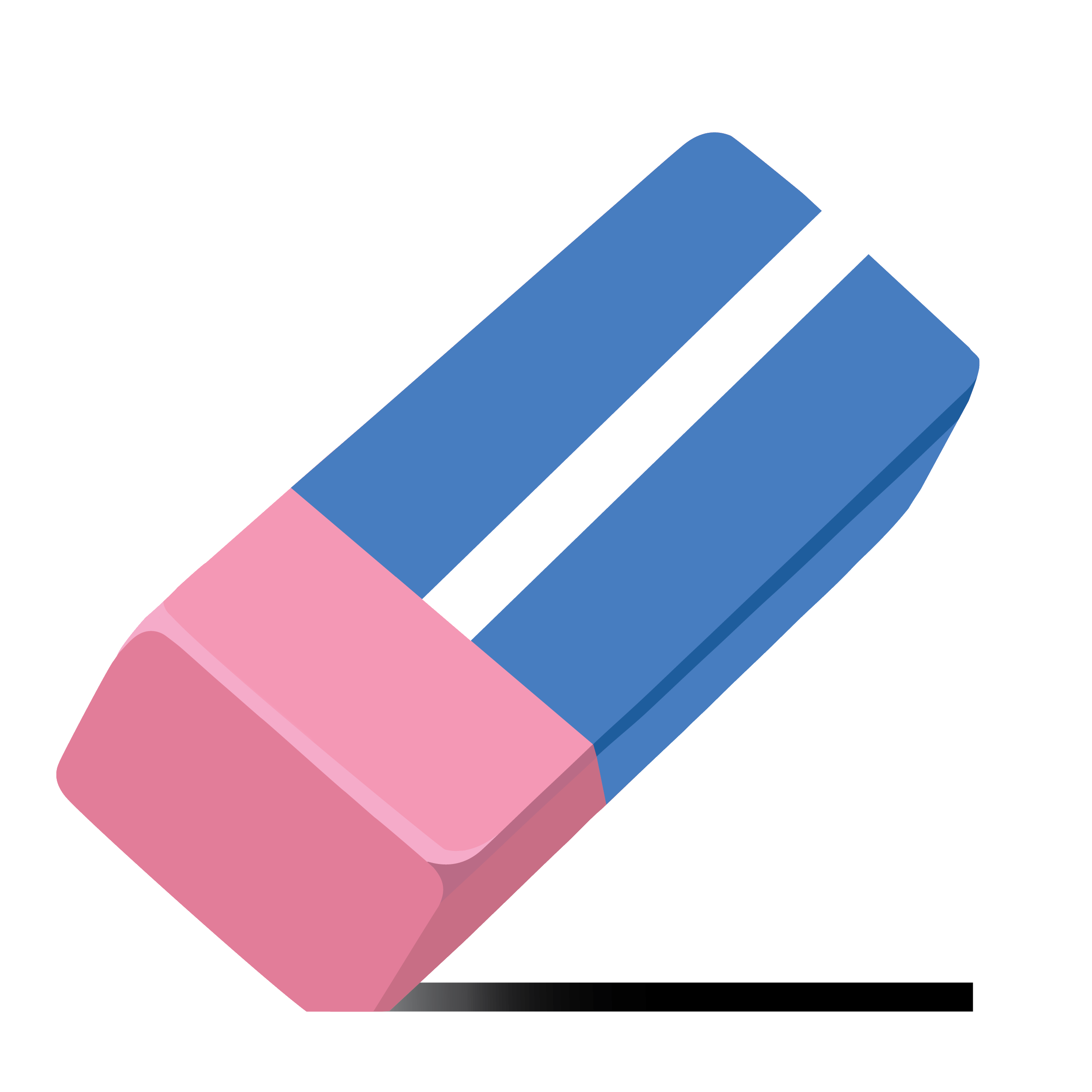
- 2025Unicode 18.0 draft list includes an Eraser emoji (), proposed as a natural companion to the pencil.
The character U+270F was added in Unicode 1.1 in June 1993, making it one of the oldest characters that later became an emoji. It originated from the Zapf Dingbats typeface. It was officially recognized as an emoji in Emoji 1.0 in 2015.
Not yet, but an Eraser emoji ([eraser]) is on the Unicode 18.0 draft list for 2026/2027. If approved, it would arrive on most platforms in 2027, giving the pencil its natural companion after 33 years.
Around the world
In Japan, the pencil carries particular weight in education culture. Japanese students are taught to use pencils (specifically HB or B-grade) through most of elementary school before graduating to mechanical pencils in middle school. The pencil emoji resonates strongly with school-age nostalgia there.
In the US, the #2 pencil (known as HB internationally) is practically a cultural artifact. It's synonymous with standardized testing, from the SAT to bubble-sheet scantrons. The yellow Dixon Ticonderoga, first introduced in 1913, is often called "America's pencil."
In Chinese culture, the color yellow on pencils has a deeper resonance. When Koh-i-Noor Hardtmuth chose yellow for their premium pencils in 1889, it was a deliberate reference to Chinese imperial color symbolism, where yellow represented royalty, wisdom, and glory.
Because real pencils are yellow, and that tradition dates to 1889 when Czech company Koh-i-Noor Hardtmuth painted their premium pencils yellow to signal they used Chinese graphite. Yellow was the Chinese imperial color, symbolizing royalty and quality. All major emoji vendors (Apple, Google, Samsung, Microsoft) render ✏️ as a yellow pencil.
Desk stationery emoji search interest, 2020-2026 (normalized)
Writing emoji family: search interest over time
✍️ Writing Hand has dominated the writing emoji family since 2020, but the real story is 📝 Memo's surge. Through 2023, ✏️ and 📝 were neck-and-neck. Then Memo exploded in mid-2024, driven by #StudyTok and note-taking app culture, and now sits firmly in second place. ✏️ has grown steadily but can't keep up. 🖊️ and 🖋️ barely register.Often confused with
📝 Memo is a sheet of paper with a pencil writing on it. It's about the document or note being created. ✏️ is the tool itself. Use 📝 for note-taking, lists, and reminders. Use ✏️ for drawing, sketching, and the act of creating.
📝 Memo is a sheet of paper with a pencil writing on it. It's about the document or note being created. ✏️ is the tool itself. Use 📝 for note-taking, lists, and reminders. Use ✏️ for drawing, sketching, and the act of creating.
✍️ Writing Hand shows a hand holding a pen mid-write. It emphasizes the person writing, while ✏️ emphasizes the tool. ✍️ is also heavily used in the ✍️between✍️words✍️ format on TikTok to emphasize a lesson. ✍️ is roughly 2x more searched than ✏️.
✍️ Writing Hand shows a hand holding a pen mid-write. It emphasizes the person writing, while ✏️ emphasizes the tool. ✍️ is also heavily used in the ✍️between✍️words✍️ format on TikTok to emphasize a lesson. ✍️ is roughly 2x more searched than ✏️.
🖊️ is a Ballpoint Pen, the grown-up cousin. Pens imply permanence and commitment (contracts, signatures). Pencils imply drafts, sketches, and things you can erase. When in doubt: pen for official, pencil for provisional.
🖊️ is a Ballpoint Pen, the grown-up cousin. Pens imply permanence and commitment (contracts, signatures). Pencils imply drafts, sketches, and things you can erase. When in doubt: pen for official, pencil for provisional.
🖋️ Fountain Pen is the formal, elegant writing tool. Think calligraphy, poetry, literary pretensions. ✏️ is the humble classroom workhorse by comparison.
🖋️ Fountain Pen is the formal, elegant writing tool. Think calligraphy, poetry, literary pretensions. ✏️ is the humble classroom workhorse by comparison.
✏️ is the writing tool itself (pencil). 📝 is a document with a pencil writing on it (memo/notepad). Use ✏️ when emphasizing the tool, drawing, or sketching. Use 📝 when emphasizing the notes, lists, or written content.
✏️ shows the pencil as an object. ✍️ shows a hand in the act of writing. ✍️ is also used in the popular ✍️between✍️words✍️ format on TikTok and Twitter to emphasize a point. ✍️ is roughly 2x more popular in search volume.
Writing emoji popularity ranking
Do's and don'ts
Caption ideas
Fun facts
- •U+270F was encoded in Unicode 1.1 in 1993, making it older than most people who use it. It predates the web browser.
- •The character came from Hermann Zapf's Zapf Dingbats typeface, designed in the 1970s for the International Typeface Corporation.
- •Yellow pencils exist because of a 1889 marketing campaign by Koh-i-Noor Hardtmuth. They chose yellow to reference Chinese imperial color symbolism, since their graphite came from China.
- •The name "pencil" comes from the Latin "pencillus" meaning "little tail," originally referring to a small brush.
- •A single pencil can draw a line roughly 35 miles long or write approximately 45,000 words before running out of graphite.
- •The first graphite deposit suitable for pencils was found in Borrowdale, England in 1564. It was so pure it could be sawn into sticks and used directly.
- •In Argentina, pencils are called "lapiceras" and in some regions the Dixon Ticonderoga is so iconic that "Ticonderoga" is used generically for any yellow pencil.
- •An Eraser emoji is on the Unicode 18.0 draft list for 2026/2027, designed as a companion to the pencil. It took 33 years for the pencil to potentially get its other half.
- •Japanese elementary students are required to use pencils (typically HB or B grade) through most of their primary education before switching to mechanical pencils in middle school.
Trivia
- Pencil Emoji (emojipedia.org)
- U+270F PENCIL (codepoints.net)
- Dingbats (Unicode block) (wikipedia.org)
- Why Are Pencils Yellow? (rd.com)
- The origin of the iconic yellow pencil (freerangehistory.substack.com)
- Why Are Pencils Yellow? (pencils.com)
- Pencil (Wikipedia) (wikipedia.org)
- History - Ticonderoga (weareticonderoga.com)
- Google Trends: Writing Emojis (trends.google.com)
- Draft Emoji List for 2026/2027 (blog.emojipedia.org)
- Emoji Design Convergence Review: 2018-2026 (blog.emojipedia.org)
- Google Standard Unicode Emoji Mapping (2008) (unicode.org)
Related Emojis
More Objects
Share this emoji
2,000+ emojis deeply researched. One click to copy. No ads.
Open eeemoji →