
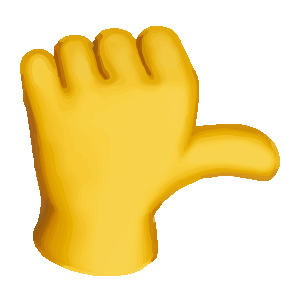
Right-facing Fist Emoji
U+1F91C:fist_right:Skin tonesAbout Right-facing Fist 🤜
Right-facing Fist () is part of the People & Body group in Unicode. Added in Unicode E3.0. Type on GitHub and Slack to use it. On Discord it's . Click copy above to grab it, paste it anywhere.
Works in iMessage, WhatsApp, Discord, Slack, Instagram, Twitter, Gmail, and every app that supports Unicode. Pick a skin tone above to customize it.
Often associated with fist, right-facing, rightwards.
Meaning varies across cultures, see cultural notes below.
Scroll down for the full story: meaning, trends, combos, and more.
How it looks
What does it mean?
A fist facing to the right, designed to pair with 🤛 (left-facing fist) to form a fist bump: 🤜🤛. On its own, it can represent a punch thrown to the right, but its primary purpose is the two-part greeting.
Emojipedia describes it as a fist shown from the side, facing right. The emoji exists specifically to create the fist bump sequence when placed next to its mirror partner. A real fist bump requires two hands meeting. The emoji version requires two emoji.
Before 🤜 and 🤛 existed (pre-2016), people used 👊👊 for fist bumps, but since both fists face the viewer, it looked like double punching rather than bumping. Unicode fixed this in Emoji 3.0 (2016) by adding directional fists, part of proposal L2/16-308 by Peter Edberg (Apple/Emoji Subcommittee).
The fist bump supports mixed skin tones (e.g., 🤜🏾🤛🏻), which lets the gesture represent two different people. That detail makes the pair more versatile than any single-hand emoji for representing a shared moment between individuals.
Approved in Unicode 9.0 (June 2016) as RIGHT-FACING FIST.
🤜 almost always appears paired with 🤛 to form the fist bump (🤜🤛). The combo is a digital greeting, a congratulations, or a sign of solidarity between friends. "Great work 🤜🤛" or "Let's do this 🤜🤛" are the classic uses.
On its own, 🤜 can mean punching (the fist is in motion from left to right). But this solo use is far less common than the paired fist bump. The emoji was designed as half of a pair, and it feels incomplete without the other half.
The fist bump emoji got a cultural boost during COVID. A 2014 study published in the American Journal of Infection Control found that handshakes transfer 10 times as many bacteria as fist bumps. When the pandemic made handshakes feel risky, fist bumps became the recommended alternative, and 🤜🤛 became the digital version of this safer greeting.
In gaming and esports, 🤜🤛 is the standard team celebration after a win. In workplace Slack channels, it's a casual "well done" that feels less formal than 👏 and more collaborative than 👍.
A fist bump: a friendly greeting, congratulations, or solidarity gesture. The two directional fists meeting represent two people bumping fists. It's the digital version of "nice one" or "we did it."
Multiple claims exist. Stan Musial used it in the 1950s-60s to avoid germs. NBA rookie Fred Carter popularized it in 1970 in a Baltimore Bullets locker room. The Wonder Twins brought it to TV in 1977. TIME magazine credits Carter as one of the earliest practitioners.
Yes. A 2014 study published in the American Journal of Infection Control found handshakes transfer 10 times as many bacteria as fist bumps. The smaller contact area and shorter duration reduce germ spread. COVID health officials recommended it as a safer greeting.
The fist emoji family
Bacteria transfer by greeting type
What it means from...
Between friends, 🤜🤛 is the casual "nice" or "let's go." It's warmer than 👍 and less formal than 🤝. "Good game 🤜🤛" or "See you tonight 🤜🤛" are standard.
Not flirty. 🤜🤛 signals friendship, not romance. If your crush sends you a fist bump, they see you as a buddy. It's the emoji equivalent of the friendzone handshake. Nobody's heart races over a fist bump.
Common in casual work cultures (tech, startups, gaming). "Shipped the feature 🤜🤛" or "Nice PR 🤜🤛" works in Slack. In formal industries (law, finance), it might feel too casual.
From a stranger online, 🤜🤛 signals camaraderie or shared victory. "We're both waiting in this queue 🤜🤛" or "Same opinion 🤜🤛" creates instant solidarity.
Emoji combos
Origin story
The fist bump started on basketball courts. One winter evening in 1970, an NBA rookie named Fred Carter walked into the Baltimore Bullets locker room and did something unexpected: he strolled up to Wes Unseld, the team's 6-foot-7 center, and extended his fist. Then he bumped fists with Gus Johnson and Earl Monroe. Carter wanted to hype up his teammates before the game. TIME magazine credits him as one of the earliest practitioners, if not the inventor.
But there's an earlier claim. Baseball Hall of Famer Stan Musial used the fist bump in the 1950s and 60s because he was convinced he was catching too many colds from shaking thousands of hands each year. His motivation was germs, not style. He was ahead of the science by six decades: a 2014 study confirmed that handshakes transfer 10 times as many bacteria as fist bumps.
The gesture went mainstream through pop culture. In 1977, the Wonder Twins on Hanna-Barbera's Super Friends cartoon touched fists and cried "Wonder Twin powers, activate!" before shapeshifting. Some credit this as the fist bump's national TV debut. Then in 2008, Barack and Michelle Obama's fist bump on stage at the final Democratic primaries became one of the most-discussed gestures in political history. Fox News anchor E.D. Hill called it a "terrorist fist jab" on air. Her show was cancelled within a week. Her Fox contract wasn't renewed.
The emoji version arrived in Unicode 9.0 (2016). 🤜 () and 🤛 () were designed specifically as a pair. Before them, the only fist emoji was 👊 (oncoming fist), which faces the viewer and can't form a convincing side-by-side bump. Peter Edberg's proposal L2/16-308 solved this by adding directional fists that could meet in the middle.
The fist bump through history
Design history
- 2016Approved in Unicode 9.0 as RIGHT-FACING FIST (U+1F91C), paired with LEFT-FACING FIST (U+1F91B)↗
- 2016Part of Emoji 3.0 release with skin tone support from day one
- 2020Usage surges during COVID as fist bump becomes recommended hygienic greeting
Around the world
The fist bump is overwhelmingly an American export. It spread from US basketball and hip-hop culture to the rest of the world, accelerated by the Obama moment in 2008 and the COVID pandemic in 2020.
In formal business cultures (Japan, Germany, much of Europe), a fist bump in a first meeting would feel jarring. The handshake or bow remains the expected greeting. In Silicon Valley and tech culture, fist bumps are common even in professional settings, reflecting the industry's casual norms.
During COVID, the fist bump became a recommended alternative to handshakes worldwide. Health officials pointed to the 2014 study showing 10x fewer bacteria transferred. The gesture crossed cultural boundaries it hadn't before: Middle Eastern diplomats, European politicians, and Asian business leaders all adopted it as a temporary hygiene measure. Some of those habits stuck.
Howie Mandel, the Deal or No Deal host, made the fist bump famous as a germaphobia accommodation. His OCD-driven refusal to shake hands, documented in his autobiography *Here's the Deal: Don't Touch Me*, turned the fist bump into a recognized alternative for people with touch aversion.
In June 2008, Fox News anchor E.D. Hill described Barack and Michelle Obama's fist bump as a potential 'terrorist fist jab.' Her show was cancelled within a week and her Fox contract wasn't renewed. The incident made the fist bump front-page news.
Often confused with
🤛 is the left-facing fist, the other half of the fist bump. They're designed as a pair: 🤜🤛. Using only one is like doing a fist bump into empty air.
🤛 is the left-facing fist, the other half of the fist bump. They're designed as a pair: 🤜🤛. Using only one is like doing a fist bump into empty air.
👊 (oncoming fist) faces the viewer: a punch coming toward you, or a fist bump aimed at the reader. 🤜 faces sideways and is meant to meet 🤛. 👊 is personal (aimed at you). 🤜🤛 is between two others.
👊 (oncoming fist) faces the viewer: a punch coming toward you, or a fist bump aimed at the reader. 🤜 faces sideways and is meant to meet 🤛. 👊 is personal (aimed at you). 🤜🤛 is between two others.
✊ (raised fist) is vertical and political (solidarity, protest). 🤜 is horizontal and personal (fist bump, greeting). Different gesture, different context. You raise ✊ at a rally. You extend 🤜 to a friend.
✊ (raised fist) is vertical and political (solidarity, protest). 🤜 is horizontal and personal (fist bump, greeting). Different gesture, different context. You raise ✊ at a rally. You extend 🤜 to a friend.
Do's and don'ts
Without 🤛 beside it, 🤜 reads as a punch (fist moving to the right). The solo use is less common because the emoji was designed as half of a pair. For a standalone fist bump, use 👊 instead.
Depends on the culture. In tech, startups, and casual workplaces, it's fine for celebrating wins. In formal industries (law, finance, diplomacy), use 🤝 instead. The fist bump reads as informal peer-to-peer, not superior-to-subordinate.
Caption ideas
Aesthetic sets
Type it as text
Fun facts
- •Fred Carter of the Baltimore Bullets is credited by TIME as one of the earliest fist bumpers, bumping fists with teammates in a locker room in the winter of 1970.
- •Baseball Hall of Famer Stan Musial used the fist bump in the 1950s-60s because he was convinced he caught colds from shaking thousands of fans' hands. His hygiene instinct was validated 60 years later.
- •Handshakes transfer 10 times as many bacteria as fist bumps. The 2014 study used E. coli-coated rubber gloves to measure bacterial transfer across greetings. Fist bumps won by a landslide.
- •The Wonder Twins on Hanna-Barbera's Super Friends (1977) may be the first nationally televised fist bump. "Wonder Twin powers, activate!" with fists touching became a pop culture catchphrase.
- •Fox News anchor E.D. Hill called the Obamas' fist bump a "terrorist fist jab" in June 2008. Her show was cancelled. Her contract wasn't renewed. The incident is one of the most famous self-own moments in cable news history.
- •In Big Hero 6, the Baymax fist bump scene went through many iterations. Voice actor Scott Adsit improvised the "ba-la-la-la-la" sound. Entertainment Weekly published a full oral history of just this one scene.
- •🤜🤛 supports mixed skin tones (e.g., 🤜🏾🤛🏻), allowing the fist bump to represent two different people. This makes it one of the few emoji gestures that can depict an interaction between distinct individuals.
- •Howie Mandel made the fist bump famous on Deal or No Deal as an OCD accommodation. His autobiography is titled Here's the Deal: Don't Touch Me.
Common misinterpretations
- •🤜 alone (without 🤛) reads as punching, not greeting. If you mean a fist bump, always pair them. Solo 🤜 in response to someone's message can read as "I want to punch this" rather than "let's celebrate."
- •In formal cultures, the fist bump (even as an emoji) can feel too casual. A Japanese or German colleague receiving 🤜🤛 after a deal might expect 🤝 instead.
- •Confusing 🤜🤛 (greeting) with ✊ (political solidarity). They're visually similar but contextually different. One is personal, the other is political.
In pop culture
- •Fred Carter and the NBA (1970) — Baltimore Bullets rookie Fred Carter is credited by TIME magazine as one of the earliest fist bumpers. He bumped fists with Wes Unseld, Gus Johnson, and Earl Monroe in the locker room to hype up his teammates. The gesture spread through basketball and into broader sports culture.
- •Wonder Twins (1977) — The Wonder Twins on Hanna-Barbera's Super Friends cartoon touched fists and cried "Wonder Twin powers, activate!" before shapeshifting. Some consider this the fist bump's national TV debut. The phrase became a pop culture catchphrase that outlived the show by decades.
- •Obama fist bump (2008) — Barack and Michelle Obama's on-stage fist bump became one of the most discussed gestures in political history. Fox News anchor E.D. Hill called it a "terrorist fist jab", which got her show cancelled and her contract terminated.
- •Big Hero 6's Baymax (2014) — The Baymax fist bump ("Ba-la-la-la-la") became one of Disney animation's most beloved moments. Hiro teaches his robot companion to fist bump, and the gesture returns at the film's emotional climax when Baymax seemingly sacrifices himself. EW published an oral history of just the fist bump scene.
- •**Howie Mandel's *Deal or No Deal*** — Mandel's OCD and germaphobia made him famous for fist-bumping contestants instead of shaking hands. His autobiography is literally titled Here's the Deal: Don't Touch Me. He made the fist bump a recognized accommodation for people with touch aversion.
- •Stan Musial (1950s-60s) — Baseball Hall of Famer Stan Musial may have predated Fred Carter by two decades. He fist-bumped fans because he was convinced he caught colds from shaking thousands of hands. His instinct was validated 60 years later by the 2014 bacteria study.
Trivia
For developers
- •Codepoint: . Unicode name: RIGHT-FACING FIST. Part of Unicode 9.0 (2016), Emoji 3.0.
- •Skin tone modifiers: through . Mix skin tones across the pair: is valid and represents two different people.
- •Common shortcodes: or (Slack, Discord). Some platforms also accept .
- •The fist bump sequence (🤜🤛) is two separate codepoints, not a ZWJ sequence. Line-breaking algorithms may split them across lines. Use on the container if you need them to stay together.
- •Designed as a pair with (🤛 LEFT-FACING FIST). Test both together when building emoji pickers or reaction systems.
Yes. 🤜🏾🤛🏻 works perfectly. The two fists can have different skin tones, representing two different people. This makes the paired gesture useful for depicting diverse interactions.
See the full Emoji Developer Tools guide for regex patterns, encoding helpers, and more.
How do you use 🤜🤛?
Select all that apply
- Right-Facing Fist Emoji — Emojipedia (emojipedia.org)
- A Brief History of the Fist Bump — TIME (time.com)
- Fist bump — Wikipedia (wikipedia.org)
- The fist bump: a more hygienic alternative — PubMed (2014) (pubmed.ncbi.nlm.nih.gov)
- Coronavirus might kill the handshake — ZME Science (zmescience.com)
- Fox anchor calls Obama fist bump 'terrorist fist jab' — HuffPost (huffpost.com)
- Big Hero 6: How A Fist Bump Gag Became Emotional — Screen Rant (screenrant.com)
- Wonder Twins — Wikipedia (wikipedia.org)
- Howie Mandel and His OCD — ABC News (abcnews.go.com)
- More Hand Gestures (L2/16-308) — Unicode.org (unicode.org)
- Fist bump or handshake etiquette — Ellevate (ellevatenetwork.com)
Related Emojis
More People & Body
Share this emoji
2,000+ emojis deeply researched. One click to copy. No ads.
Open eeemoji →