
The Flirty Emoji Ladder: A Sender's Guide to 15 Emojis
You have a match. You want to flirt. You pull up the emoji keyboard and freeze, because the distance between 😊 and 💦 is not a gradient, it is a cliff, and every emoji between them is a negotiation you have to get right on the first try. The good news is that there is a ladder, and almost everyone under 40 is already climbing the same one.
This is a sender’s guide. It is organized by escalation, not alphabetically. The goal is simple: figure out which rung you are on, then decide whether to stay there or climb. The rungs come from how people actually use these emojis in dating apps and private DMs, backed by a Clover analysis of three million messages, a UBC study of sexual emoji with 693 participants, and the Match.com Singles in America survey that polled 5,675 singles.
The fifteen emojis on the ladder, tap to copy
Why the ladder exists
Text takes your voice away. It strips out tone, eye contact, the pause before a punchline, the half-smile that tells someone you are joking. Emojis are the replacement voice track. They are the reason a sentence reads as flirty instead of dry, as warm instead of cold. When you skip them, a new match reads your message as corporate. When you overdo them, you sound desperate. The ladder is the dial.
The data backs this up. Match.com found that 54% of emoji users had sex in 2014 compared to 31% of non-emoji users, and emoji users were two times more likely to want to get married. The causal arrow is murky (emoji users also text more, and more texting means more escalation opportunities) but the correlation is sharp. People who flirt with emojis win more.
The ladder, all five rungs
Tap any rung in the widget below to see what it signals, who you should be sending it to, where it sits on the first-message-to-first-date clock, and the specific landmine that can blow it up. Each rung has three copyable example DMs.
The Flirt Ladder
Tap a rungRung 2: Playful interest
Okay, this is flirting. But cute flirting.
Clear interest, still reversible. You are putting chips on the table but not the whole stack. The 👀 is the Gen Z version, 😏 is the millennial version, and your recipient's age determines which reads as flirty vs smug.
- Send to
- Someone who already flirted back once. A match who responded with their own emoji. An old friend where the vibe just shifted.
- When on the message clock
- Message five through the first date. Also the reply-to-a-thirst-trap rung.
- Landmine
- Samsung renders 😏 with narrow eyes and a pronounced smirk that reads as condescending, not coy. If your recipient is on a Galaxy, expect delivery to land rougher than intended.
The rest of the post walks through each rung in order, because the most common mistake is skipping one. A 🥵 three messages into a match is not romantic, it is a notification that you are operating two rungs ahead of the person you are talking to. Climbing one rung at a time is the whole strategy.
Rung 1: Plausible deniability (😊 😉 😅 🙃)
These are the soft openers. A 😊 after a compliment says “I mean this warmly.” A 😉 at the end of a sentence turns it into a joke with a wink. A 😅 admits you are nervous in a way that is disarming, not alarming. The wink emoji in particular has been the standard opener move on dating apps for over a decade, landing between sincere and ironic depending on the context.
The 🙃 is the Gen Z ironic addition to this rung. It performs flippancy while communicating something slightly more serious, and Emojipedia’s emojiology entry catalogs it as one of the main emojis people use in the early stages of flirty texting. Everything on this rung is low-stakes. That is the point.
Rung 2: Playful interest (😏 👀 🧐 😚)
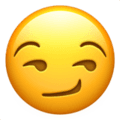
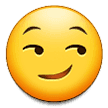
The 😏 is the emoji Clover’s three-million-message study flagged as the most common one men send women. In the UBC sexual emoji study, the smirking face was one of the three most common faces in sexually suggestive messaging along with the wink and the blowing-a-kiss face. It signals knowing interest. You are not pretending to be neutral anymore, you are making a face.
The 👀 is the Gen Z equivalent. Where a millennial sends 😏 after a slightly suggestive line, a person under 25 sends 👀 (the wider generational split in emoji meaning runs through every rung on this ladder). The Quillbot breakdown frames it as “I see you,” which is exactly the right tone: acknowledging something without naming it. Our Google Trends data below shows 👀 has dominated searches for flirt-emoji meaning every quarter since 2021, peaking sharply in Q3 2022.
The chart below tracks how often people google these five rung-one and rung-two emojis to figure out what they mean. The 👀 (blue) towers over the others, which is the strongest available signal that it is the most actively misread flirt emoji of the last five years.
Source: Google Trends, 2021-2026
Rung 3: Warm affection (😘 😚 🥰 🤭)
This rung is where flirting becomes a relationship. The 😘 is a kiss, and unlike the next rung up, it is still sweet rather than sexual. A 🥰 is the softer version, specifically what Emojipedia describes as the emoji for being freshly, unmistakably smitten. Both are blushing, happy, wholesome. Neither is appropriate on a first date.
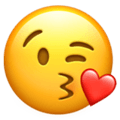
The difference between 😘 and 😚 matters more than it looks. A blown kiss 😘 is performative and outward, something you send to a partner at the end of a workday. A closed-eyes kiss 😚 has the eyes shut, which reads as savoring it. The closed eyes take it from greeting to moment.
Rung 4: Explicit attraction (🥵 🤤 😈 👅)
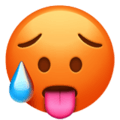
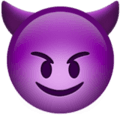
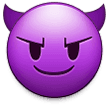
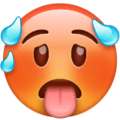
The 🥵 hot face emoji arrived in Unicode 11.0 in 2018 and went straight to the top of the thirst-emoji shortlist. Its Emojipedia entry lists “physical attractiveness” as its primary use. The 🤤 drooling face says the same thing with a different texture. The 😈 is the confident, playful version. The 👅 is the most direct, often paired with 💦 to make the pairing explicit.
Rung 4 requires established mutual interest. The UBC study’s finding that 51% of suggestive-message senders reported that emojis led directly to sexting means that these emojis are not decorative. They are the escalation. Sending 🥵 to someone who has only sent you 😊 back is jumping three rungs at once, and the survey data on what women do not reply to (eggplant, flexed biceps, fist bump) all trace back to the same problem: emojis that skip the ladder.
Rung 5: The spicy objects (🍑 🍆 💦 🔥)
The 🍑 has not meant fruit in a decade. When Apple tried to redesign it to look more like a peach in 2016, users revolted so hard Apple reverted the design within weeks. Wikipedia’s eggplant emoji entry has a full section titled “use as a euphemism for the penis.” The 💦 paired with either means exactly what you think it means. The 🔥 is the softer member of this rung, usable as a compliment on an attractive photo without being fully sexual, but in combination with the others it slots in.
Clover’s dataset is blunt here: the eggplant was one of the top emojis women did not reply to from cold openers, along with the clapping hands, flexed bicep, and fist bump. The pattern is clear. Rung 5 emojis are not opener emojis. They are established-dynamic emojis. Send them to someone who has sent them to you first, or do not send them at all.
The Samsung smirk problem
The single biggest cross-platform misfire on the flirt ladder is 😏 rendered on a Samsung phone. Apple draws the smirking face as a coy, slightly-raised-brow expression that reads as knowing interest. Samsung draws the same codepoint with narrow eyes and a pronounced smirk that reads, to most observers, as condescending or creepy. If you are an iPhone user flirting with a Galaxy user, your intended coy 😏 is landing as a smug look.
The 🥵 has its own platform gap (Samsung’s version sweats more dramatically than Apple’s, which pushes it further toward literal heat and away from attraction), and 😈 varies in devilishness from platform to platform. The faceted grid below lets you filter by platform so you can see what your recipient is actually seeing.





















When to climb: the message clock
The ladder maps roughly onto the message clock, and mapping wrong is the second most common flirt misfire after platform mismatch. Messages one through five live on rung 1. Messages five through first date live on rung 2. Rung 3 opens up after the first good date. Rungs 4 and 5 require established mutual dynamic. Tawkify’s 2026 opener playbook puts it this way: an average opener converts at 0.6% match-to-conversation; a good one converts at 3-5%. The good ones almost all live on rung 1 or 2.
Climbing too fast is the male-sender pattern that dating apps see most often. A Hinge 2024 finding noted personalized openers get 50% more replies than generic greetings, and personalization is a rung-1 move, not a rung-4 move. The correct escalation is to stay one rung behind where you want to be and let the reply pull you up.
The Valentine’s spike, visualized
Flirt-emoji searches are seasonal. The chart below tracks monthly interest in “flirty emoji” from January 2021 through April 2026, with the devil emoji as a comparison line. The February spikes are visible every year: 2024 hit 70, up from 51 the month before; 2023 hit 64, up from 57. December also spikes, which is partly holiday photo-posting and partly end-of-year dating-app engagement. The overall trend is up; people are searching for flirty-emoji meaning roughly twice as often in 2026 as they were in 2021.
Source: Google Trends, monthly 2021-2026
Google’s own Valentine’s Day data confirms the cultural weight of this: in their search-trends breakdown, the heart-eyes 😍, red heart ❤️, face blowing a kiss 😘, and rose 🌹 are the emojis that surge hardest in February. The ladder in this post shifts downward briefly during V-Day week; people send warmer, rung-3 messages to people they might otherwise keep on rung 2.
Reading the reply
The reply tells you what rung the other person is climbing to. A rung-1 opener (😊) that gets a rung-1 reply (😊) means stay on rung 1 for a bit. A rung-1 opener that gets a rung-2 reply (😏 or 👀) means you can climb. A rung-3 message (😘) that gets a rung-1 reply (😊) means you overshot, and should step back down next time.
The other signal to watch is emoji count. One is always fine. Two is warm. Three or more on the same message is an avalanche, and avalanches almost always read as trying too hard. The exception is when both people are avalanching at each other, which happens on established rung-3 and rung-4 dynamics and is a good sign.
What not to send
The high-variance emojis below are technically on the ladder but misfire badly when the dynamic is not established. Skip them until you are certain.
Clover's study put the eggplant in the top four emojis women do not reply to from strangers. Not subtle, not ambiguous. On rung 5 it works fine inside an established sexting dynamic. From a new match it reads as harassment.
Clover also flagged the flex as a non-starter. Meant as a compliment to your own gym photos, it reads as bragging. Gen Z uses it ironically, which is a fourth-layer of meaning most recipients will not unpack.
One 😈 is confident. Four in a row is a warning sign. The same codepoint reads as playful in isolation and as unhinged in repetition.
The 🙃 reads as flirty ironic from Gen Z and as anxiously-attached from anyone older. If you are over 28, it is doing more work than you want.
The single biggest red flag on the flirt ladder. Repeating the same rung-4 emoji more than twice in a row is never calibration, it is escalation without consent, and it is the move most likely to get you unmatched.
The core lesson is unchanged across a decade of dating-app research. Emojis work when they add tone to a real message and fail when they replace one. A Carphone Warehouse survey on dating bios found bios with too many emojis perform worse than text-only bios, even though messages with well-placed emojis perform better than messages without. The difference is whether the emoji is doing work (tone, warmth, joke) or whether it is there because you did not know what to say.
One rung at a time. Let the reply pull you up. Do not send a 🍆 to someone who has not sent you a 🍑 first. And if you are on a Galaxy, remember that your 😏 looks very different to your match than it does to you. If the conversation ever moves to a work Slack, the whole ladder resets; that is a different playbook, covered in the workplace emoji dictionary.
- Dating App Clover Reveals The Best Emojis To Use In Opening Messages Online (globaldatinginsights.com)
- The Most Popular Dating App Emoji Is Not What You'd Think (Clover 3M message study) (entrepreneur.com)
- Are you fluent in sexual emoji? (Wentland et al., UBC, Canadian Journal of Human Sexuality) (utppublishing.com)
- UBC Okanagan Researchers Study Most-Commonly Used Emojis in Sexts (huffpost.com)
- Match.com's 2014 Singles in America Survey: What Emoji Say About Sex (time.com)
- New Dating Survey Reveals People Who Use Emojis Have More Sex (mic.com)
- What Does The 😏 Smirking Face Emoji Mean? (Emojipedia Emojiology) (emojipedia.org)
- Emojis & Dating Apps: Rizz, Romance, Icks & Others (emojipedia.org)
- 10 emojis you didn't know look completely different based on your smartphone (reviewed.com)
- Eggplant emoji (Wikipedia) (wikipedia.org)
- Peach emoji (Wikipedia) (wikipedia.org)
- How Gen Z uses emoji as punctuation (Washington Post) (washingtonpost.com)
- 4 trends search reveals about Valentine's Day (Think with Google) (thinkwithgoogle.com)
- 34 Tinder Openers: The 2026 Playbook (tawkify.com)
- 👀 Eyes Emoji meaning and examples (Quillbot) (quillbot.com)
- 🥵 Hot Face Emoji (Emojipedia) (emojipedia.org)
- 😘 Face Blowing a Kiss Emoji (Emojipedia) (emojipedia.org)
- Match Messaging Mastery: The Essential Guide for 2025 (Winged) (wingedapp.com)
- Dating App Bio Emoji Survey (Bustle/Carphone Warehouse) (bustle.com)
