
The 🫡 Salute: Gen Z's Most Honest Emoji Lie
The saluting face 🫡 is the only emoji on your keyboard that can mean “I respect you,” “I heard you,” and “I hate this” in the same Slack thread. It is the three-way mirror of digital communication, and the only reason it works is that everybody has quietly agreed to pretend the ambiguity is a feature.
Dictionary.com describes it as showing “respect, admiration, deference, agreement, or obedience with the purest, most earnest, unironic sincerity, or with the most sarcastic snark and not-so-subtle resistance imaginable.” That is not a definition. It is a surrender. The salute means whatever context tells it to mean, and the people who use it fluently read the context first and the emoji second.
Salute adjacent, tap to copy
The three-way emoji
Every emoji has a default reading. 😂 is funny, 🔥 is hot, 💀 is “I’m dead from laughing.” 🫡 does not have one. It has three, and they sit so close together that the wrong pick makes the sender look either earnest in a joke context or rude in a sincere one. The three registers are worth naming properly because that is the only way to think about the emoji without getting hurt.
Genuine, acknowledgment, sarcastic
The first register is genuine respect. This is the Veterans Day reading, the “thank you for your service” reading, the Queen’s funeral reading. The salute operates like a hand on a heart. The second register is acknowledgment, the Slack “on it 🫡” reading, which works as a digital nod. Efficient, warm, almost military in its brevity. The third register is the sarcastic compliance reading, the “another all-hands meeting 🫡” reading, where the emoji performs obedience so aggressively that the performance becomes the protest.
The dial above is a simplification. In the wild the readings bleed into each other, and a single salute can ride two rungs at once. A friend who texts is pinging rung three (respect pop) but leaning toward rung two (acknowledgment) because they also want to validate the move. Nothing about 🫡 is binary. The New York Times called it “Saluting in Solidarity” when describing the Twitter layoffs, and that phrase does the best job of capturing how rungs one and four can both be live at the same time. You are respecting someone while also acknowledging that the situation is absurd.
From o7 to Unicode 14.0
Before 🫡 there was o7. The text salute (where the o is a head and the 7 is a raised arm) emerged in the EVE Online player community around 2004. EVE is a space MMO where losing a ship is permanent, friendly fire is legal, and betrayal is lore. In that world, a quick typed salute was valuable. It meant “I come in peace” or “good fight” or “fly safe.” The earliest documented definition is an Urban Dictionary entry from April 30, 2007.
From EVE the gesture jumped to Elite Dangerous, where “o7 Commander” became the default greeting, then to Star Citizen, then to Twitch chat, where it became a way to respect a streamer’s play or mourn a lost character. By the late 2010s o7 had reached the mainstream of online gaming culture but never quite escaped it.
The emoji version was a top request for years. An Emojipedia 2018 survey ranked the saluting face high, and it appeared again in the 2019 rankings. In August 2019, Google’s emoji design lead Jennifer Daniel and Shiraz Fuman filed L2/19-396, the Saluting Face proposal.
The proposal had to solve a design problem most emojis do not have: salutes are aggressively cultural. The US military version keeps the palm angled inward, the British and Commonwealth version shows the palm outward, the French raise the whole forearm, and several countries with fascist histories have banned salute gestures that look even slightly Roman. As Daniel wrote on her Substack, the team had to invent a hybrid gesture that belongs to no single tradition. The final emoji is a diplomat. It can also read as “shielding your eyes from the sun” or “looking for something,” which is part of why it is the only salute design most countries will accept.
After Elon Musk's "extremely hardcore" ultimatum, hundreds of Twitter employees choose to leave. Internal Slack channels fill with 🫡 as a dignified goodbye. The New York Times covers it as "Saluting in Solidarity." When Meta and Amazon announce layoffs in the months that follow, their Slacks do the same thing.
Unicode 14.0 approved 🫡 as U+1FAE1 in September 2021, alongside 🫠 melting face, 🫶 heart hands, and 🥹 face holding back tears. Apple shipped it in iOS 15.4 in March 2022. Most users only had the emoji for six months before its defining cultural moment hit.
The breakout year
2022 was, in retrospect, the year the salute got its job. Three things happened in rapid order, and each pushed 🫡 into a slightly different register.
Queen Elizabeth II’s state funeral
In September, Queen Elizabeth II died. Her state funeral on September 19 was the first global event where most smartphone users had 🫡 on their keyboards. Condolence posts across Twitter and Instagram filled with saluting faces for the eleven days of mourning. This was rung one: pure respect, no irony, the emoji doing exactly what its name says. The Queen’s funeral gave 🫡 its gravitas.
The Twitter layoffs that made it a labor gesture
In November, Elon Musk bought Twitter and issued his “extremely hardcore” ultimatum. When the deadline passed, internal Slack channels filled with 🫡 as employees announced their departures. The Seattle Times described the salute as “a symbol inside Twitter of respect for those who are leaving,” and Business Standard called it “the placard of the digital world.” When Meta and Amazon announced their own layoffs weeks later, their Slacks did the same thing. This was the moment 🫡 stopped being a gaming import and became a labor gesture.
Rolling Stone’s emoji of the year
In December, Rolling Stone named 🫡 the best emoji of 2022. The magazine credited its range: an emoji that could hold “grim acceptance of fate” and “earnest respect” at the same time was exactly the emoji 2022 needed. By the end of the year the salute had traveled from EVE Online pilots to global funerals to mass layoffs to a magazine cover, all in about fourteen weeks.
Search interest since 2020
Google Trends tells the story in one picture. Search volume for “salute emoji” was nearly flat through 2020 and 2021, then nearly doubled in the summer of 2022, and spiked to its all-time high in November 2022 during the Twitter layoffs. “o7 meaning,” the legacy search, also peaked in July and August 2022 as the gaming-adjacent and tech-adjacent corners of the internet started looking up the same gesture. The more specific “saluting face emoji” query barely registers because almost nobody searches the full Unicode name, they just paste the glyph.
Source: Google Trends
The chart also explains why the salute has not faded the way most breakout emojis do. Unlike 🥺 or 💀, which peaked with specific meme cycles, 🫡 found three permanent jobs: funerals, farewells, and Slack. Those categories are evergreen, so the search volume never fully reverts. The November 2022 Twitter spike is the tallest bar, but the baseline after it is about twice what it was before.
The workplace subtext
The most interesting place to watch 🫡 is a Slack channel at a company with more than 200 employees. That is where all three registers collide, and where the generational divide on emoji reading is sharpest. An Atlassian and YouGov survey of 10,000 workers across the US, France, Germany, India, and Australia found that 88% of Gen Z workers think emojis help convey tone at work, versus only 49% of Gen X and Boomers. The same survey found that Gen Z is 2.5 times more likely to feel motivated by an emoji reaction on their message than Boomers.
The split matters because it means the same 🫡 in a Slack thread is read differently by the junior and the senior in the conversation. To the junior, it is a range of registers. To the senior, it is often just a nod or, increasingly, a weirdly curt acknowledgment. The same conversation researchers who have been arguing for two years that Gen Z reads 👍 as passive-aggressive now say the salute is doing the same thing in reverse: juniors use 🫡 sarcastically, seniors read it as compliance, and everyone leaves the thread with a different memory of what was said.
The phrase “yes chef” from FX’s The Bear crossed into office Slacks the same year 🫡 did, and the two paired naturally. A coworker posting a brutal Q3 deadline in a channel, followed by three or four “yes chef 🫡” replies from the team, became a recognizable workplace ritual by 2023. It works because the chef line and the salute do the same thing: they perform obedience loudly enough that the performance itself becomes a safe release valve.
Combos that hold up at work
How 🫡 looks across platforms
The design variance on 🫡 is unusually wide. Apple and Huawei show only half the face behind the saluting hand, a choice that makes the gesture dominant at thumbnail size. Google’s version, designed by the same team that proposed the emoji, shows the full face with the hand raised to the temple. Emojipedia has noted that Twitter’s version (from the Twemoji set) has intense eyebrows and a straight mouth, which is part of why the Twitter-layoff version read as grim acceptance rather than cheerful compliance. The emoji you send is not the emoji your recipient sees.
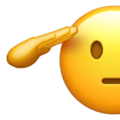





The practical takeaway is that if you are sending 🫡 to someone on a Samsung phone or a Windows machine, you are sending a slightly different emoji than you typed. The Samsung and Microsoft designs are more cartoonish than Apple’s, which tilts the reading toward rung three (ironic) rather than rung one (genuine). If the message is a funeral tribute, this matters. If it is a Slack thread, probably not.
How to use it without misfiring
The salute is the highest-risk easy emoji on the keyboard. It is easy because there is only one version and the name is descriptive. It is risky because the default reading depends entirely on the sender-receiver relationship. These are the most common misfires.
Salute landmines
The patterns that make a 🫡 land badly are boringly consistent. These are the ones to watch.
If you sarcastically salute a request that your manager actually means seriously, you have just performed compliance and silently opted out of the pushback. They will read it as yes. You meant no.
If a friend tells you their parent died, 🫡 reads as weirdly formal. A salute is for the funeral post, not the personal DM. Use ❤️ or 🫂 in the DM and save 🫡 for the public tribute.
Someone says you look great. A 🫡 back reads as deflection, as if you are refusing to accept the compliment. Use 🥹 or 🫶 instead.
The salute needs context. Without a prior message, 🫡 as an opener reads as passive-aggressive or sarcastic. It is a closer, not a hello.
Three or more saluting faces in a row stops reading as respect and starts reading as a bit. Fine in the group chat. Not fine in the condolence post.
When you are the recipient, the reading is almost always context-first. A coworker you trust sends 🫡 to a Friday calendar invite? Rung four, they think the meeting is pointless. A teammate sends 🫡 to a project kickoff? Rung two, they are signed on. A stranger on Twitter sends 🫡 to your promotion announcement? Rung three, they respect the move. A family member sends 🫡 to grandma’s obituary? Rung one, no irony. If the context does not tell you which rung, ask. The salute is the one emoji where “is that genuine or sarcastic” is a normal question to get.
What replaced the salute
The last big 🫡 story was about its absence. In March 2025, The Atlantic revealed that US cabinet officials had accidentally added editor Jeffrey Goldberg to a Signal group planning strikes against the Houthis in Yemen. When the strikes hit, National Security Advisor Michael Waltz reacted with 👊🇺🇸🔥. The reaction went viral, mostly for what it was not. There was no 🫡.
The missing salute was the point. The 2022-era 🫡 carried weight: it implied gravity, dignity, solemnity. The 2025-era 👊🇺🇸🔥 is cheerleading. It is the emoji vocabulary of a victory group chat, not a military action. Commentators at Slate and Yahoo Finance noted that the substitution told you something about how seriously the group was taking the operation. If that chat had used 🫡, the optics would have been very different. It would have read as respect for risk. Fist-bumps and flames read as end-zone dance.
Every breakout emoji eventually gets a replacement. 😂 got replaced by 😭 for the Gen Z laughing default. 👍 got quietly demoted as juniors started reading it as rude. The open question for 🫡 is whether the ironic-compliance reading eats the genuine-respect reading, which would push the emoji into the same rhetorical grave as 🙏 (stuck between “please” and “high five” and finally “thanks”). The generational data suggests the splits are widening, not narrowing. A Boomer saluting a colleague in 2026 and a Gen Z saluting the same colleague mean two different things in the same thread.
For now, 🫡 is still doing its three jobs. It is the emoji of funerals, the emoji of farewells, and the emoji of ironic yes-sir. If you want the safest usage, stick to rung two: acknowledgment. A short Slack “on it 🫡” is read the same way across generations, across platforms, and across moods. That single rung is where the salute earns its keep, and probably where it will still be in ten years, long after everyone has forgotten that it came from a space MMO called EVE and a British Queen’s funeral that happened to fall in the same calendar quarter.
- Saluting-Face Emoji Proposal (L2/19-396) (unicode.org)
- I Salute You, Saluting Face Emoji (jenniferdaniel.substack.com)
- Saluting Face on Emojipedia (emojipedia.org)
- Saluting in Solidarity (NYT) (nytimes.com)
- Why the saluting-face emoji is having a moment (Seattle Times) (seattletimes.com)
- Saluting Face is the Best Emoji of 2022 (Rolling Stone) (rollingstone.com)
- Amid tech layoffs, saluting-face emoji is the placard of the digital world (business-standard.com)
- What Does The 🫡 Saluting Face Emoji Mean? (emojipedia.org)
- Saluting face on Dictionary.com (dictionary.com)
- Thoughts on o7 outside of Eve (EVE Online forums) (eveonline.com)
- Urban Dictionary: o7 (2007) (urbandictionary.com)
- Are you fluent in Gen Z's digital body language? (Atlassian & YouGov) (atlassian.com)
- Thumbs up: good or passive aggressive? (The Conversation) (theconversation.com)
- How 'The Bear' turned chefs into sex symbols (The Ringer) (theringer.com)
- State funeral of Queen Elizabeth II (NPR) (npr.org)
- Twitter employees quit after Musk's ultimatum (NPR) (npr.org)
- United States government group chat leaks (Wikipedia) (wikipedia.org)
- Michael Waltz's emoji trio reaction (Axios) (axios.com)
- iOS 15.4 Emoji Changelog (Emojipedia) (emojipedia.org)
