
Emoji Overtime: Which Single Emoji Works the Hardest?
We have a staffing problem in the emoji economy. A small handful of glyphs are doing the work of an entire emoji set while the other 3,940 emojis clock in for one task and clock out. 🔥 has at least six jobs. 💀 was hired to represent death and now pulls a full shift as a punctuation mark. 🙏 files timesheets under “prayer,” “thanks,” “high five,” and “itadakimasu.”
This is our formal HR review of the emoji workforce. Who is working hardest, which ones are fifteen years past a promotion, and why the Unicode Consortium has never once intervened on behalf of a single overworked glyph.
The thirteen hardest-working emojis on your phone
What counts as a “job”
A “job” here means a distinct documented meaning, not a variation in tone. If two different Emojipedia, Dictionary.com, or Know Your Meme entries list the same meaning, we count it once. If an emoji does completely different things in two contexts (🔥 the compliment versus 🔥 the Snapchat streak badge), each context counts.
Linguists would call this polysemy, and a 2021 study from researchers at Edinburgh, Essex, Oxford, and the Alan Turing Institute measured it across 1.7 billion tweets. Most emoji stayed semantically stable over six years. A small group took on new jobs constantly. The ones below are that small group.
Usage share numbers in each case are editorial estimates drawn from qualitative reads of how each meaning shows up in the wild, not a validated survey. Treat them like the back of an HR napkin, not a peer-reviewed table.
The overtime leaderboard
Ranked by number of distinct jobs, with a union grievance per worker. The top of the list is ruthless: the #1 emoji is covering six unrelated roles, none of which are the one Unicode originally hired it for.
Union grievance: Clocks the most overtime in the dataset: attractive, excellent, trending, Snapstreak, literal fire, and weed in hip-hop slang since 1993.
- That's hot28% of use“new headshots 🔥”
- That's excellent26% of use“his verse on that track 🔥”
- Trending / lit17% of use“party tonight is gonna be 🔥”
- Snapchat streak12% of use“we're on 🔥 day 84”
- Literal fire / danger10% of use“kitchen is on 🔥 call 911”
- Weed / intoxicated7% of use“this batch is 🔥”
Job counts are editorial based on documented meanings in Emojipedia, Dictionary.com, and Know Your Meme entries. Usage shares are rough estimates from qualitative reads of how each job shows up across X, TikTok, and messaging, not a validated survey.
Four case studies
The leaderboard tells you who is overworked. These four deep dives tell you what the shifts actually look like. Each emoji below gets a ready-to-send example for each of its main jobs, tap to copy.

🔥 The six-job champion
Fire has been doing slang duty since the early 1990s, when hip-hop started using “fire” as an adjective for high-quality cannabis. Modern texters then stacked another five meanings on top, which is how you end up with a single pictograph that simultaneously means “attractive,” “excellent,” “Snapchat streak,” “literal fire,” and “lit” in the intoxicated sense. Tinder used it as a logo, which is either recognition or exploitation depending on how you feel about gig work.
💀 The one that should not be funny
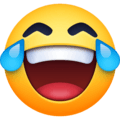
A published study from 2024 argues 💀 now functions as a tone tag and as punctuation, not just as a word. Gen Z promoted it to “I am dead from laughing” specifically because the face with tears of joy got branded as millennial and therefore unusable. The skull does the same job with less earnestness. The pile-up intensifies the laugh: one 💀 is a chuckle, three 💀💀💀 is respiratory failure.

👀 The social engineer
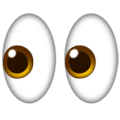
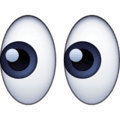
Two eyes and no face, so every possible motive stays on the table. Dictionary.com documents at least six jobs: lurking, intrigue, suspicion, thirst, drama-watching, and the “called out” subtweet response. It works because eye contact in real life is the most context-dependent gesture humans have, and the emoji kept that property. No other emoji can mean “I want to date you” and “I think you did the crime” depending on whether it arrives after a selfie or a screenshot.

🤡 The self-own
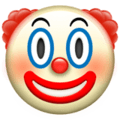
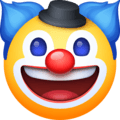
Parade and most Gen Z emoji guides agree: 🤡 rarely points outward. It is primarily a self-directed “look at this fool”, deployed after texting an ex back, falling for a phishing email, or entering a second situationship with the same person. The clown industry itself is not thrilled about this, which is probably the only true negative review of a clown emoji on record.
Search interest since 2020
If an emoji has a clear job, nobody googles it. People only ask “what does X emoji mean” when the glyph in front of them is doing five things at once. Here is the Google Trends curve for the decoder queries on our top four overworked emojis, from January 2020 through February 2026.
Source: Google Trends
Eyes is the permanent decoder champion, which tracks with its six documented jobs and the fact that it is often the only emoji in a message. Skull surged from late 2021 through mid-2023 as it stole work from 😂, then dipped as the meaning calcified and people stopped needing to ask. Fire is a background constant. Clown is a flatline, because when someone sends you a 🤡 the meaning is always obvious and it is always you.
The one-job emojis (for reference)
Every overworked emoji has a foil: a glyph Unicode designed for exactly one purpose that has never once been reassigned. These are the opposite of overtime. They clock in, do one thing, clock out, and go home to their families.
🥯 bagel still means bagel. 🧑🔧 mechanic still means mechanic. 🪪 ID card is still an ID card. ⛽ gas pump only appears when someone needs gas or when a car meme is in progress. 🪧 placard is probably the single most underutilised glyph on your phone. It shipped in 2021 with one meaning and still has that meaning now.
The lesson, per Gretchen McCulloch’s Because Internet, is that semantic drift happens when a word, or glyph, is useful enough to get pulled into a lot of sentences. The bagel is just not that useful.
How the overworked ones render

An additional indignity: the hardest-working emojis also have to cope with platform variance. Apple’s 💀 grins. Samsung’s 💀 looks concerned. Google’s 🔥 reads as a campfire, Microsoft’s 🔥 reads as a gas-station accident. The same word-of-the-year candidate, four different fonts, and one overworked polysemous sign.





























































Right tool, right job
The practical case for caring about any of this is that overworked emojis are ambiguous by definition. If you need a message to land unambiguously (a coworker chat, a text to someone’s parents, a DM across an age gap), pay a specialist instead of asking a generalist to pull another shift. Two examples.
The HR conclusion
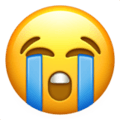
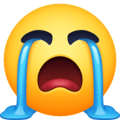
Thirteen emojis are doing the emotional labour for an entire keyboard. The top four (🔥, 💀, 😭, 🙏) have more documented meanings between them than the Oxford English Dictionary has entries for the word set, which is twenty-two, though the OED entry for set is notorious for a reason. The takeaway is not that anyone should stop using them. It is that you should know, when you send a 🫡 or a 😊, that the emoji will be read by whoever is best at reading it, and you are mostly not them.
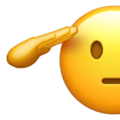
Unicode is currently reviewing 150+ new proposals. None of them will reduce the load on 🔥. If you want more on one of the workers above, the 🫡 salute has its own case file and we ranked every emoji by real usage earlier this year. That is the deal with language. The useful signs get dragged into every sentence and the one-job ones wait on the bench. Go easy on the fire emoji today.
- Emojipedia: most popular emojis (emojipedia.org)
- Meltwater: Top emojis of 2025 (meltwater.com)
- Dictionary.com: fire emoji (dictionary.com)
- Dictionary.com: eyes emoji (dictionary.com)
- Dictionary.com: 100 emoji (dictionary.com)
- Dictionary.com: Gen Z explains emoji to millennials (dictionary.com)
- Emojipedia: what does the saluting face emoji mean? (blog.emojipedia.org)
- Emojipedia: folded hands emojiology (blog.emojipedia.org)
- The skull emoji as tone tag and punctuation (research) (researchgate.net)
- Semantic Journeys: measuring emoji meaning change 2012 to 2018 (arxiv.org)
- Alan Turing Institute: emoji are more like language (turing.ac.uk)
- Know Your Meme: skull emoji (knowyourmeme.com)
- Today: Gen Z wants millennials to know the laugh-cry emoji is over (today.com)
- Bustle: Gen Z says the smiley face emoji is passive aggressive (bustle.com)
- Parade: 20 Gen Z emojis and what they mean (parade.com)
- Wikipedia: Sparkles emoji (wikipedia.org)
- Emojipedia: the sparkles emoji is everywhere (blog.emojipedia.org)
- Because Internet, Gretchen McCulloch (penguinrandomhouse.com)
