
Broken Chain Emoji
U+26D3 U+FE0F U+200D U+1F4A5About Broken Chain ⛓️💥
Broken Chain () is part of the Objects group in Unicode. Added in Unicode E15.1. On Discord it's . Click copy above to grab it, paste it anywhere.
Works in iMessage, WhatsApp, Discord, Slack, Instagram, Twitter, Gmail, and every app that supports Unicode.
Often associated with break, breaking, broken, and 3 more keywords.
Meaning varies across cultures, see cultural notes below.
Scroll down for the full story: meaning, trends, combos, and more.
How it looks
What does it mean?
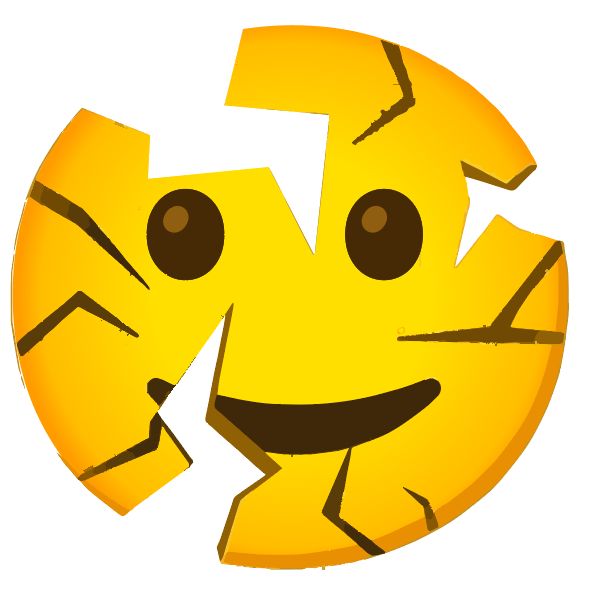
A chain link snapped in two, with a collision burst around the break. The visual is one of the most loaded images in human history, compressed into four code points.
The emoji carries two parallel meanings, and which one you see depends almost entirely on who sent it. World-historical: emancipation, abolition, the end of slavery, the fall of colonial rule. Personal: leaving a bad job, getting out of a toxic relationship, a year sober, the first generation in a family that stops passing a trauma down. Both are real, both are correct, and the same glyph ends up in a Juneteenth post and a cycle-breaker TikTok on the same day.
Added in Emoji 15.1 in September 2023 and rolled out to iOS and Android in March 2024, broken chain is a ZWJ sequence: ⛓️ (chains) + ZWJ + 💥 (collision). Proposed by Jennifer Daniel on behalf of the Unicode Emoji Subcommittee, it was designed to fill what the proposal called "a notable gap" in the emoji set: the symbol of freedom itself.
Daniel wrote on her Substack that the chain can stand for "the limitations we set on ourselves, the stereotypes others place on us, the assumptions that society makes about us". That flexibility is why the emoji hit harder than most 2023 additions. It works literally (a snapped bike chain, a dropped connection, a dead URL) and it works as a whole cosmology of liberation.
Three lanes, and they barely overlap.
Political and historical. Spikes hard around Juneteenth (June 19, US federal holiday since 2021), independence days across the Global South, and Abolition Day commemorations. Museums, activists, and civil rights accounts use it in posts about emancipation, decolonization, and anti-trafficking work like Human Rights Watch's #BreakTheChains campaign. Usage here is solemn, reverent, and date-driven.
Personal liberation. The bigger lane in daily texting. "Finally quit ⛓️💥", "one year sober today ⛓️💥", "signed the lease on my own place ⛓️💥". Therapy-speak culture embraced it fast because "cycle breaker" was already a viral phrase before the emoji existed, and now the phrase has a glyph. Common in cycle-breaker TikToks, sobriety milestone posts, divorce announcements, and recovery accounts.
Literal and ironic. Gen Z will use it for a bicycle chain that actually snapped, a supply chain meme, a broken blockchain, or a group chat that died. Emojipedia noted the emoji turned out to be surprisingly versatile shorthand for "things coming apart," including "feeling like you personally are the weakest link."
Peak posting windows: mid-June (Juneteenth), July 4, July through September (global independence days), New Year (cycle-breaker resolution posts).
A chain breaking apart. Symbolizes freedom and liberation at every scale: historical emancipation (Juneteenth, abolition, independence days), personal liberation (leaving toxic relationships, sobriety, cycle-breaking), and literal breakage (snapped chains, dead URLs, ended streaks).
Where ⛓️💥 actually lands in daily use
The Chain Family
What it means from...
If your crush sends ⛓️💥, they're almost certainly talking about something else entirely: an ex, a bad habit, a situation they just got out of. It isn't a romantic signal. If anything, it's a "finally single" flag worth paying attention to.
Ambiguous and worth clarifying. Between partners it can mean "we survived something together" or "this is over." If it shows up cold with no other context, ask.
Almost always celebratory. A friend sending ⛓️💥 is announcing a win: quit the job, left the relationship, hit a sobriety milestone, moved out of their parents' place. Match their energy with ✊ or 🕊️.
Heavy. In family group chats this often lands as "cycle-breaker" language, the first person in a lineage to stop a pattern. Also common in Black family chats around Juneteenth.
"Last day ⛓️💥" is the classic. Also "Friday ⛓️💥" the week someone finally ships a nightmare project. Professional liberation is a real use case.
On public posts, default to the activist or historical reading: emancipation, independence, social justice. Personal liberation posts are usually in replies and DMs, not open feeds.
Flirty or friendly?
Not flirty. The emoji's gravitational pull is freedom, not intimacy. In relationship contexts it almost always signals an ending or an escape, not a deepening. If someone sends it during a flirty exchange, they're probably telling you they just got free of someone else.
No. The emoji is about freedom, not intimacy. In a relationship context it usually signals an ending or an escape. If a crush sends it, they're almost always talking about a different situation they just got out of, not your relationship.
Emoji combos
Origin story
The broken chain has been a symbol of freedom for at least three centuries. The 1787 medallion "Am I Not a Man and a Brother?", designed by Josiah Wedgwood for the Society for Effecting the Abolition of the Slave Trade, showed an enslaved man in broken shackles. It became the most recognizable abolitionist image of its era. Thomas Ball's 1876 Emancipation Memorial in Washington DC depicts Lincoln standing over a formerly enslaved man rising from broken chains. The Abolition of Slavery memorial in Nantes, France, does the same. The shackle cut in two is what freedom looks like in stone.
Jennifer Daniel's proposal to Unicode argued that this symbol was missing from the keyboard. She cited its use in commemorating Emancipation Days, Abolition Days, and Independence Days worldwide, and noted that ✊ (raised fist) and 🕊️ (dove) had long carried some of this load but neither captured the specific idea of a constraint being broken.
The technical elegance of the design is its own story. Instead of a new code point, Daniel proposed a ZWJ sequence: take the existing ⛓️ chains emoji, join it to the existing 💥 collision burst, and let the renderer merge them into a single glyph. This is the same technique used for 🧑🚀 (astronaut) and 👨👨👧 (family). It creates a new concept from parts users already have, which is cheaper, faster to ship, and degrades gracefully on older systems as ⛓️💥 side by side.
In the US, the emoji quickly became tied to Juneteenth, which became a federal holiday in 2021 and commemorates June 19, 1865, when enslaved people in Galveston, Texas, learned of their emancipation, two and a half years after the Emancipation Proclamation. Emojipedia's first major post featuring the emoji after its platform rollout was tagged #Juneteenth.
Added in Emoji 15.1 (September 2023) and shipped to iOS 17.4 and Android 15 in March 2024. ZWJ sequence: (Chains) + + (ZWJ) + (Collision). Four code points, one glyph. Proposed by Jennifer Daniel on July 14, 2022, on behalf of the Unicode Emoji Subcommittee.
Design history
- 2022Jennifer Daniel files proposal [L2/23-036](https://www.unicode.org/L2/L2023/23036-broken-chain.pdf) on behalf of the Unicode Emoji Subcommittee (July 14).
- 2023Emoji 15.1 approved in September. Broken chain is among the first ZWJ sequences in the release.
- 2024Ships to iOS 17.4 and Android 15 in March. Emojipedia features it heavily around Juneteenth in June.
- 2024Samsung, WhatsApp, and Microsoft roll out their own designs through the year.
- 2025First full cultural cycle. "Cycle breaker" TikToks adopt it as the default visual.
Around the world
The broken chain resonates everywhere but the specific reference shifts by region. In the US, it's Juneteenth and the abolition of slavery. In the Caribbean and Latin America, it's independence from colonial powers and the end of slavery on different dates: Haiti 1804, Brazil 1888, Jamaica 1962. In West and East Africa, it anchors decolonization and independence day celebrations. In Eastern Europe, it reads as the fall of communism and liberation from authoritarian rule. In India, it connects to Independence Day) and to the symbolic chains shown in partition-era art.
The personal meaning (cycle-breaking, sobriety, leaving bad relationships) travels across all cultures roughly equally, because the metaphor of being bound and breaking free is older than any of them.
Juneteenth (June 19) commemorates the emancipation of enslaved people in the US. Broken shackles have been the visual shorthand for abolition since at least 1787. When the emoji shipped in March 2024, Emojipedia and civil rights accounts made the connection explicit during the June 19 commemoration, and it stuck.
For Juneteenth specifically, yes, with care. Amplify Black creators, educators, and organizations rather than leading with yourself. Attach it to actual content, not a generic "happy holidays" post. For the personal-liberation meaning (sobriety, therapy, leaving a job) there's no identity gate.
Juneteenth search interest, 2020 to 2026
Often confused with
Chains (⛓️) means binding, constraint, or connection. Broken chain (⛓️💥) means the opposite: liberation. Same base, inverted meaning. In rap and hip-hop contexts, ⛓️ can also mean "chain" as in jewelry, which has nothing to do with either.
Chains (⛓️) means binding, constraint, or connection. Broken chain (⛓️💥) means the opposite: liberation. Same base, inverted meaning. In rap and hip-hop contexts, ⛓️ can also mean "chain" as in jewelry, which has nothing to do with either.
⛓️ (chains) means binding or connection. ⛓️💥 (broken chain) means the opposite: liberation. Same base image, inverted meaning. The collision burst does the work of "broken."
Do's and don'ts
- ✓Use for liberation, sobriety, cycle-breaking, and leaving bad situations
- ✓Use for Juneteenth, emancipation days, and independence celebrations
- ✓Pair with substance when posting about Juneteenth, amplify Black voices rather than leading with your own
- ✓Use ironically for a snapped bike chain or a dead group chat, the literal read is fair game
- ✗Trivialize historical liberation by attaching it to minor inconveniences
- ✗Use it in a flirty exchange and assume the other person knows you mean "I'm free" not "we're over"
- ✗Post it on Juneteenth without any actual content or context
- ✗Confuse it with ⛓️ (chains), the meanings are opposite
They're saying they're the first person in their family to stop a multi-generational pattern: abuse, addiction, poverty, silence, whatever. The phrase predates the emoji by years, but ⛓️💥 is now the default visual for it on TikTok and Instagram.
Caption ideas
Aesthetic sets
Fun facts
- •The chain breaking as a freedom symbol goes back to the 1787 Wedgwood medallion, the most recognizable abolitionist image of its century.
- •Proposed by Jennifer Daniel in July 2022, approved September 2023, shipped March 2024. Faster than average for a new emoji.
- •It's one of the few ZWJ sequences that creates a conceptually new emoji rather than a variant of an existing one (like 👩🚀 = woman + astronaut). Chain + collision = liberation.
- •Jennifer Daniel's own pitch for the emoji: "emancipation, broken block-chains, breaking streaks, and dead urls." She packed four meanings into one sentence.
- •On unsupported platforms it renders as ⛓️💥, two emojis side by side. Still readable. Graceful degradation is a feature of the ZWJ approach.
- •Juneteenth (June 19) became a US federal holiday in 2021. The broken chain emoji arrived in 2023. The commemoration waited two years for its dedicated symbol.
- •Human Rights Watch's #BreakTheChains campaign targets the shackling of people with mental health conditions in 60+ countries. The hashtag predates the emoji; the emoji now travels with it.
In pop culture
- •Cycle breaker discourse. The phrase "cycle breaker" predated the emoji by years (Psychology Today used it in 2022), but once ⛓️💥 shipped it became the default visual for TikToks and therapy-speak posts about ending generational patterns.
- •Human Rights Watch #BreakTheChains. HRW's campaign against the shackling of people with mental health conditions in 60+ countries adopted the emoji after its rollout. The campaign has helped free thousands of people in Ghana, Indonesia, Nigeria, and Somaliland.
- •Sobriety milestone culture. Recovery accounts on X and Instagram use ⛓️💥 for sobriety anniversaries. The match with existing "one day at a time" iconography was immediate.
- •Juneteenth brand posts. Since 2024, major brands posting on Juneteenth have leaned heavily on ⛓️💥. Emojipedia tracked it as the most-used emoji in Juneteenth posts in its 2024 and 2025 roundups.
Trivia
For developers
- •ZWJ sequence: + + + . Four code points.
- •Fallback render on unsupported systems: ⛓️💥 (chain + collision, side by side). Meaning survives.
- •Added in Emoji 15.1 (September 2023). Device support: iOS 17.4+, Android 15+, macOS 14.4+, Windows 11 23H2+. Older OSes will fall back.
- •One of the few ZWJ sequences that creates a conceptually new emoji rather than a variant of an existing base (like 👩🚀).
- •If you're building an emoji picker, this lives under "Objects > Tools" in CLDR annotations, not under "Symbols."
See the full Emoji Developer Tools guide for regex patterns, encoding helpers, and more.
What does ⛓️💥 mean to you most of the time?
Select all that apply
- Broken Chain Emoji (Emojipedia)
- L2/23-036 Chain with Broken Link Emoji Proposal (Unicode)
- Breaking the Curse ⛓️💥 (Jennifer Daniel)
- Breaking the Cycle 🔗💥 (Jennifer Daniel)
- Gen Z's Chaotic, Ironic Emoji Swapping Meme (Emojipedia Blog)
- #BreakTheChains campaign (Human Rights Watch)
- Juneteenth (Wikipedia)
- Am I Not a Man and a Brother? (1787 medallion) (Wikipedia)
- Emancipation Memorial (Wikipedia)
- What is a Cycle-Breaker? (Psychology Today)
Related Emojis
More Objects
Share this emoji
2,000+ emojis deeply researched. One click to copy. No ads.
Open eeemoji →