
⌛ vs ⏳: Yes, There Are Two Hourglass Emojis
Open your emoji keyboard and find the hourglass. Now find it again. There are two of them. ⌛ has all the sand at the bottom. ⏳ has sand still falling. They look like the same drawing rotated 180 degrees. They are not. Different drawings, different Unicode codepoints, seventeen years apart, opposite meanings. Almost everyone alive uses them interchangeably anyway.
That is fine. The split is mostly a piece of Unicode trivia. But the trivia is funny, the rules are real, and on Snapchat the difference between the two has, by some accounts, ended friendships. So: which one is which, when do you send each, and why has Unicode been quietly carrying both for fourteen years?
The wait-and-time corner of Unicode
The two-hourglass test
Quick check. Look at ⌛ and ⏳ side by side. If you have to think about which is which, you are in good company. The official Emojipedia pages call them Hourglass Done and Hourglass Not Done. The Unicode Consortium calls them HOURGLASS and HOURGLASS WITH FLOWING SAND. Accessibility readers usually announce them as "hourglass done" and "hourglass not done." Most people just call them "the hourglass."
That collapse is the joke. Two distinct Unicode codepoints, with formally opposite meanings, used as one emoji by almost everybody. Even brands. Even Apple, which uses the flowing-sand variant in some of its own UI documentation and the done variant in others.
Yes, they are two emojis
⌛ is U+231B HOURGLASS. It was added to Unicode 1.1 in June 1993, inherited from the WordPerfect Iconic Symbols set that had been added to the Unicode draft in January 1991. There was no emoji concept yet. ⌛ was a generic miscellaneous-technical character meant to join the existing repertoire of clock and timekeeping glyphs that Microsoft was already shipping as the Windows wait cursor.
⏳ is U+23F3 HOURGLASS WITH FLOWING SAND. It was added in Unicode 6.0 in October 2010, seventeen years and four months later. It was part of the wholesale Unicode 6.0 import of Japan's mobile-carrier emoji sets, which also brought in the seven rail-vehicle emojis, the four mailbox states, and most of the 1990s Tokyo signage canon. The carriers had a separate flowing-sand glyph for in-progress UI, and Unicode promised to round-trip every glyph from every carrier, so it came in as its own character.
Both got formal emoji presentation in 2015 with Emoji 1.0, in the Time subcategory of Travel & Places. They have been on every keyboard ever since.
What they actually mean
The Unicode names are unambiguous. Sand at the bottom means done. Sand falling means going. Pretty straightforward, except the names are not what English speakers would naturally call them: nobody texts the words "hourglass with flowing sand" out loud. The result is a vocabulary gap. People know there are two hourglasses but cannot quickly assign meaning to which is which, so they guess and send whichever pops up first in the recents.
Linguistically, ⌛ is closer to a period and ⏳ is closer to an ellipsis. Done vs going. Over vs ongoing. The 1993 character was made for the moment a process finishes; the 2010 character was made for the moment a process is still happening. Most texts mean the latter, which is why the much younger ⏳ slightly outpaces ⌛ in real-world emoji frequency.
The miss does not blow up your text. People read context, not glyphs. But a Unicode purist who sees you use ⌛ for "I am almost there" will quietly lose their mind.
The Snapchat hourglass that ruins friendships
Snapchat is the one place the hourglass actually has stakes. The streak feature launched on March 29, 2016 with the Chat 2.0 update. Two friends who Snap each other within twenty-four hours for three consecutive days earn a 🔥 fire emoji and a streak counter. The counter goes up daily for as long as the chain holds. If both friends fail to Snap each other within a 24-hour window, the streak dies. There is no Streak Recovery for free users. The fire goes out.
Before the streak dies, an hourglass appears next to the friend's name as a warning. According to Snapchat's own help center and the cross-referenced Emojipedia entry, this warning maps to ⌛ Hourglass Done. The sand has effectively run out. For new streaks the warning shows up roughly two to four hours before the cutoff, and for very long streaks it can show up four to seven hours ahead. You see ⌛ next to your bestie's name, you have a fixed window to send them a Snap, or the 🔥 dies and the friendship-debt instrument resets to day one.
Same playbook as the Duolingo streak, and every habit-tracker app since: BeReal, Apple Fitness rings, Snapchat's own Group Streaks from September 2025. They run on loss aversion. Losing something feels worse than gaining something of equal value, so an icon that screams "you are about to lose this" works harder than any positive reminder ever will. The hourglass is that scream. The fire emoji 🔥 is what disappears if you ignore it.
Pew Research's April 2026 study on teens' experiences on TikTok, Instagram and Snapchat notes that 44% of US teen Snapchat users say the app helps their friendships, the highest score among the three platforms surveyed. Researchers also note the flip side: the streaks feature drives daily contact with friends teens admit they barely like. The hourglass is the on-ramp to that.
Platform glyphs disagree
Apple draws ⌛ as a tall navy hourglass with all the sand neatly settled. Google's Noto Color Emoji uses a flatter, more orange palette with a slightly squarer body. Samsung's OneUI gives both glyphs a thicker frame and a slightly cartoony silhouette. Microsoft's Fluent set leans into glassiness for both. WhatsApp's in-house designs are basically Twemoji. Below is the side-by-side. The visual difference between ⌛ and ⏳ is much clearer on some platforms than on others, which is part of why the distinction gets washed out in practice.
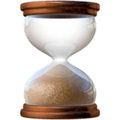
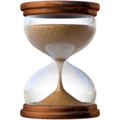
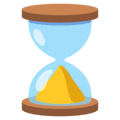
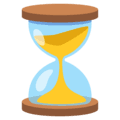
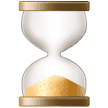
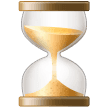


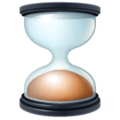
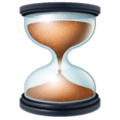


Cross-platform render mismatch is an old headache. Professor Eric Goldman's emoji case digest is full of jury screenshots where Apple's gun emoji 🔫 was a real revolver and Samsung's was a green water pistol. The hourglass split is far less consequential than that. Same mechanism, lower stakes. The emoji you send is not always the emoji your friend sees.
What people actually search for
If you want to know whether anybody actually distinguishes the two hourglasses, Google Trends is the cleanest test. Below is quarterly search interest for "hourglass emoji," "hourglass with sand emoji," "snapchat hourglass," and "loading icon" from 2021 through early 2026.
The "hourglass with sand emoji" line is a flat zero across nearly every quarter. Almost nobody on the open web searches for the official name of the flowing-sand variant. Meanwhile "loading icon," which has nothing to do with emoji at all, dominates the chart. People are not Googling the emoji, they are Googling the spinner on their screen. "Snapchat hourglass" has been steadily declining since 2021, still the loudest emoji-adjacent search but on a clear downslope as streak culture has cooled and as Snapchat itself has diluted the panic with Group Streaks and Infinite Retention.
Source: Google Trends, quarterly max
The lexical distinction between ⌛ and ⏳ is doing zero work in the wild. Adobe's 2022 U.S. Emoji Trend Report does not even bother to break them apart. For practical purposes they are one emoji split into two glyphs by an accident of Unicode history.
Pick the right hourglass
Eight scenarios. Two buttons. Pick ⌛ Hourglass Done or ⏳ Hourglass with Flowing Sand for each. The reveal explains why. No partial credit, but the decoys are honest, you will probably learn the rules in three rounds.
Pick the right hourglass
1/8You're texting a friend on the way: "almost there, give me 5 min." Which hourglass goes at the end?
When to send each
Once you internalize done vs going, the texting rules are short. Use ⌛ when a thing is over, gone, expired, or has run out. Use ⏳ when a thing is still happening, still loading, or still on the way. ⌛ pairs naturally with 🪦, 💀, and the cold "noted" energy of corporate Slack. ⏳ pairs with 👀, 🐢, 🥱, and the slow burn of waiting.
Two practical rules of thumb. If you can replace the emoji with the word "done," use ⌛. If you can replace it with "wait," use ⏳. That is genuinely the whole rule.
What not to send
The hourglass family is small but does carry a couple of texting hazards. Mostly they are about sending the wrong tense or about borrowing the glyph for slang it does not really cover.
Hourglass texting landmines
Small mistakes that change the meaning of your message. Easy to fix once you see them.
All sand at the bottom means you are not almost there, you are over. Reads as 'I gave up.' Use ⏳ for any in-progress text.
Sand still falling implies the gate is still open. The reader will reasonably ask if they can still submit. ⌛ is the correct closing punctuation.
Per Dictionary.com, Gen Z sometimes uses the hourglass for the body-shape sense. The flowing-sand variant ⏳ reads slightly more current. ⌛ in this context will be parsed as 'time is up,' which is not the compliment you wanted to give.
Snapchat's actual streak warning glyph maps to ⌛, not ⏳. If a friend texts you ⏳ to mean 'streak is dying,' you are technically receiving the wrong tense. You will still understand them.
Sending both at once cancels out. Reads as decorative or accidental. Pick one. Done or going, not both.
Why it stays this way
Unicode does not deprecate emojis. Once a character ships, it is on every keyboard forever, even if it is redundant, niche, or quietly broken. The same rule is why your phone still has a floppy disk and a fax machine. ⌛ has been in the standard since 1993; ⏳ has been there since 2010. Removing one would break every text message ever sent that used it. The committee's policy is to keep both and let usage sort it out.
Usage has not sorted it out. ⌛ and ⏳ are read as the same emoji in a coin-flip sort of way, with the original ⌛ slightly preferred for "done" and the younger ⏳ slightly preferred for "going," but neither rule is enforced. The 🛎️ bellhop bell at the front desk has had a similarly soft identity since its 1998 Wingdings 2 origin, and the spinning beach ball has quietly outlived the magneto-optical disk it was based on. Every UI lives with a few of these.
The hourglass split is a small one, but it is real. Two characters, seventeen years apart, the same drawing flipped, and a quiet rule almost nobody follows. ⌛ for done. ⏳ for going. Anything else is sand on the floor.
- Hourglass Done emoji on Emojipedia (emojipedia.org)
- Hourglass Not Done emoji on Emojipedia (emojipedia.org)
- U+231B HOURGLASS, Codepoints.net (codepoints.net)
- U+23F3 HOURGLASS WITH FLOWING SAND, Codepoints.net (codepoints.net)
- Unicode 1.1 Emoji List (June 1993) (emojipedia.org)
- Unicode 6.0 (October 2010), Wikipedia (wikipedia.org)
- How do Streaks work and when do they expire? (Snapchat Support) (help.snapchat.com)
- Introducing Infinite Retention and Group Streaks (Snap Newsroom, Sept 2025) (newsroom.snap.com)
- Timeline of Snapchat (Wikipedia) (wikipedia.org)
- Windows wait cursor (Wikipedia) (wikipedia.org)
- Spinning pinwheel (Wikipedia) (wikipedia.org)
- Throbber (Wikipedia) (wikipedia.org)
- How Gen Z Uses Emoji (Dictionary.com) (dictionary.com)
- Emojis and the Law (Eric Goldman, Washington Law Review) (digitalcommons.law.uw.edu)
- The Duolingo Streak Uses Habit Research to Keep You Motivated (blog.duolingo.com)
- Teens' Experiences on TikTok, Instagram and Snapchat (Pew Research, April 2026) (pewresearch.org)
- Adobe 2022 U.S. Emoji Trend Report (blog.adobe.com)
- Google Trends data backing this post (trends.google.com)
